The Magnificent Mekong Day 18 and Day 19

President was flying into Hanoi today so our plans for the day had to be altered due to security and his itinerary. As we were driving along you could see the American flags flying along with the Vietnamese flags.

We were to visit the Ho Chi Minh Complex but we only were able to drive by it.

Ho Chi Minh’s mausoleum was up the hill on the grounds. There already was a line to visit inside where Ho Chi Minh’s body was encased. We were to visit in the afternoon.

We could see the Presidential Palace of Vietnam. Ho Chi Minh did not live here but would greet guests. He built a stilt house on the property and that was where he lived.

The late Senator John McCain’s plane was shot down by a missile over Hanoi on October 26th, 1967. He parachuted and landed in Truc Bach Lake which we drove by and saw the memorial to him. President Biden was to visit this memorial later so there were many guards around.

The Hanoi Opera House which was also called the Grand Opera House was erected by the French Colonial administration between 1901-1911. It was upgraded in 1995 and was completed in 1997.

We walked over to there we got on electric carts to ride through the Old Quarter of Hanoi which was very busy but it was a great way to see the area.

Our electric carts

In the Old Quarter of Hanoi there were 36 streets in this neighborhood. It was always busy, many shops and fresh street food. We saw vendors selling items from their bicycles. One street still had jewelry stores, another street was full of festival decorations, and a street sold clothing and material. We passed one street with traditional medicines and herbs.

The Temple of Literature or the Temple of Confucius was founded in 1070 and had been reconstructed. This was dedicated to Confucius and was surrounded by an ancient brick wall and inside was 5 courtyards in different styles.

Temple of Literature entrance

The first courtyard in the temple.

The second courtyard was a symbol of Hanoi.

The third courtyard was a square shape and was also known as the Well of Heavenly Clarity.

The fourth courtyard featured the House of Ceremonies and the Sanctuary to Confucius.

The fifth courtyard was the grounds of the Imperial Academy.

Also housed at the Temple of Literature was one of the two largest “thundering” drums in Vietnam. They were called “thundering” drums because when hitting up they sound like thunder and were very loud.

We visited the Hoa Lò Prison which was nicknamed by the American POWS as the “Hanoi Hilton”. Most of the prison was torn down and what remained was a museum. Most of the exhibits referred to the prison’s use up to the 1950s.

Original prison layout

Can you imagine escaping from this prison through its sewer system? That was what 100 political prisoners did in 1945.

It had displays that focused on the American pilots who were kept there during the Vietnam War or the American War by the Vietnamese.

McCain’s flight suit was displayed and a photo of the Hanoi locals that rescued him out of the lake.

John McCain’s flight suit

The exhibits also showed the American POWs held here were pictured being comfortable in their barracks, which in reality was a place of interrogation and torture. Another photo showed them playing a game and smiling! This area was whitewashed. The Americans held in this prison told a very different story.

There was a memorial and sculpture at Hoa Lo Prison.

This afternoon we visited the Museum of Ethnology. This museum covered the 54 different ethnic groups in Vietnam, the Vietnamese and 53 ethnic minorities.

Museum of Ethnology

Our first stop was the outdoor exhibit area which had replicas of various traditional homes.

Inside the museum were exhibits and displays that depicted the various ethnic communities.

When we left the museum we were stuck in a traffic jam for over 45 minutes because streets were blocked off for President Biden’s motorcade! We finally got back to the hotel in time to freshen up for our last dinner together!

We all met in the lobby of our hotel but the buses couldn’t get to us because the streets were blocked again for the President’s motorcade for a dinner reception. Our buses were close to a mile away so we walked to them from the hotel. As we were walking the motorcade went by!

The traffic can’t wait to be released!

We arrived at our restaurant La Maison Vie Restaurant about an hour and a half late for our farewell dinner. The servers welcomed us and the food was delicious!

On Monday morning we checked out of our hotel and went to the Hanoi International airport to begin our journey home.

We flew from Hanoi, Vietnam to Seoul, Korea. Our next flight was from Seoul, Korea to Minneapolis, Minnesota. Our last flight was from Minneapolis, Minnesota to Columbus, Ohio. All three flights were on time and our luggage made it too! We had close connections so we were thrilled to get to Columbus on time and have our luggage arrive too! We had a fabulous trip but we were happy to get home!

The Magnificent Mekong Day 17

This morning we checked out of our hotel and went to visit Ta Prohm temple. It was used for a couple of scenes in the movie Lara Croft: Tomb Raider with Angelina Jolie.

It was built in 1186 and was a Buddhist temple.

We entered at the West entrance of Ta Prohm and walked to the East Entrance.

As we were walking we passed a group of ants that we were told to not let crawl on us because they would bite. We all steered clear!

The trees(Fig, Banyon & Kapok) and their roots had taken over much of the area and made it creepy as you walked around the grounds.

Records showed that Ta Prohm was home to more than 12,500 people which included 18 high priests and 615 dancers. More than 800,000 people who lived in the surrounding villages provided services and supplies to the temple.

It was a temple of towers, closed courtyards, and narrow corridors. Many of the corridors were impassable with piles of stone blocks dislodged by the roots of trees.

Bas-reliefs on walls were covered with lichen, moss and creeping plants.

Our guide pointed out that one of the wall reliefs that dinosaurs were carved back in the 12th century! It looked like a type of stegosaurus.

After the temple we visited the Sihanouk-Angkor Museum. The museum opened in 2008.

Norodom Sihanouk-Angkor Museum

A giant Buddha sat at the entrance to the museum.

It had a collection of 274 Buddha statues.

Just one from the Buddha collection.

The “Thousand Buddha” pillar had 1,008 small carvings of Buddha meditating and it covered all four sides.

“Thousand Buddha” Pillar

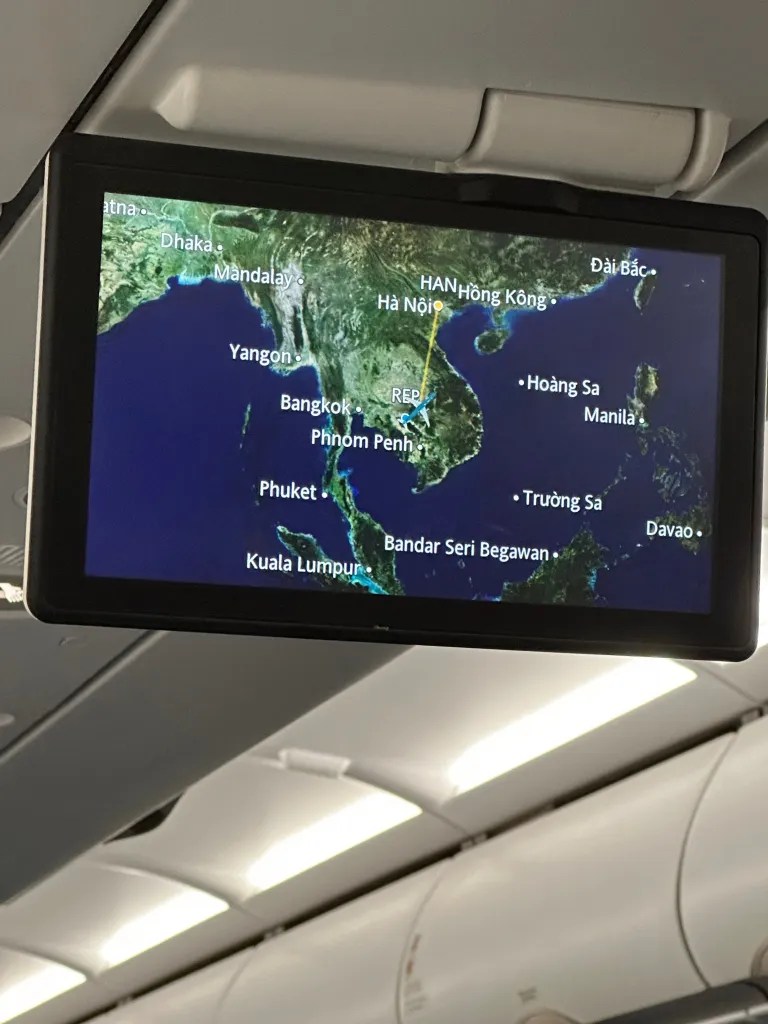
Our next stop was the airport to check-in for our flight to Hanoi. We flew on Vietnam Airlines.

When we landed in Hanoi it was close to 8:00 PM and by the time we picked up our luggage and boarded our bus to the hotel it was after 9:00 PM. The traffic and motorbikes was still very heavy!

A lot of traffic in Hanoi

We had a good view of Hanoi from our hotel room!

View from our hotel room.

Tomorrow we would be exploring Hanoi.

The Magnificent Mekong Day 9

This morning at breakfast we tried another local fruit, mangosteen or queen fruit. You peel the rind and enjoy the juicy segments inside. We didn’t take a picture of one peeled open.

Queen fruit

The picture below showed what a mangosteen peel and inside fruit looked like.

Photo credit: kwanchai.c/shutterstock

Today we took the sampan boat to Tân Châu.

When we got off the boat we got on a rickshaw for a 15-20 minute ride to the temple, Thánh Thãt Tân Châu.

Some of our rickshaws and drivers
An actual local taking a rickshaw!

When we got on the rickshaw it was raining for part of our ride. We felt sorry for our drivers. We tipped them well when we got off at the temple.

Sights as we rode around the busy town.

We got off the rickshaws at the Thánh Thãt Tân Châu.

We took off our shoes and entered the temple, women entered on the left and men on the right. It was ornate and beautiful inside.

Looking out from the temple to its entrance and the river behind.

Another boat on one of the canals off the Mekong.

We got back on our sampan for a ride to Vinh Hoa, known as “Evergreen Island”. It was one of the islands in the Makong Delta. We climbed out of our boat and walked up a path for an interesting walk on the island. It was a rural community with traditional houses up on stilts.

Traditional homes on “Evergreen Island”

The island was luscious with all kinds of vegetables growing.

Some of the neighborhood children walked with us because they didn’t have school today because tomorrow was a national Vietnam holiday. We enjoyed their company.

We visited one of the local homes and our guide translated with the mother. She was very gracious and after our question and answer time she let us visit inside her home. To get to the home there was a ramp up the front of the home. The family needed that because they keep their motorbike(s) on the porch! The home had a back staircase also.

Local family home we visited.

Her youngest was so sweet. He wove a palm leave into a beautiful butterfly and gave it to me!

Their home was made of corrugated iron and the floor in the living area was bamboo slats. This home had electricity and a small television. The home was very clean and they made good use of their limited space.

Leaving down the back staircase of the home

When our visit was finished we got back on the sampan to visit one of the many floating fish farms on the Mekong. The fish we fed were about three months old. The fish were in cages and fed once a day. The river current helped to keep the cages clean. It was a smelly place.

The video demonstrated the fish going being fed food.

After our visit to the floating fish farm we went back to the riverboat because we were crossing the Border from Vietnam to Cambodia! As were cruised along the river the Sous chef, Chef Sophors and his assistant did a demonstration on how to make fresh spring rolls. He also gave us his recipe!

Tony, our program director gave a talk about the history of Vietnam. It was an interesting talk.

Our cabin neighbor came and told us to look out our window. We did and saw a reclining Buddha up on stilts in Cambodia.

Reclining Buddha

Tomorrow we would have a busy day in Phonmh Penh, Cambodia!

The Magnificent Mekong Day 6

This morning we met with our tour directors for a short introduction to Vietnam. The program directors would be with us for the rest of our trip. We were split into 3 groups: the A family, B family, and C family. We were in the C family with Tony!

The first photo below showed where we would be visiting in Cambodia and Vietnam. The second photo showed us how to greet and show respect in those countries.

We then began our city tour. We were constantly amazed by the number of motorbikes and how they drove them, even on the sidewalks!

Our first stop was the Reunification Palace or Independence Palace. It was the home and workplace of the president of South Vietnam during the Vietnam War and it also was the site of the official signing of power during the “Fall of Saigon” on April 30th, 1975.

Taken from the palace center balcony

The palace was considered a historical monument because it was the site of the end of the Vietnam War when a North Vietnamese Army tank crashed through its gates.

A N.Vietnamese tank displayed on the palace grounds.
The Palace was also bombed in April, 1975.

We went in the palace and saw the main hall and also the President’s office, conference rooms, and a banquet hall. The War Command room was used during the Vietnam War and has been left intact with telephones, radios, maps and plotting boards.

The basement was where the communication center was located and a bunker was built during the Vietnam war to protect the President. During the bombing in 1975 the President’s entire family took refuge in the bunker.

The rooftop featured a helicopter landing area which was used for evacuation of the last Americans from Saigon on April 30th, 1975.

Helicopter on the palace roof.

From the palace we drove past the Notre Dame Cathedral which was built between 1863 and 1880. This cathedral was due to the French influence during that time period. Today is was under restoration so we couldn’t see much of its exterior.

Before going inside the Saigon Central Post Office Tony showed us the location for the famous photo of an American helicopter leaving Saigon! The picture we took was from the opposite side of the building.

The post office was built by renowned architect Gustave Eiffel, of the famed Eiffel Tower in Paris, in the late 1800’s. It was well preserved and the workers still hand stamp the mail and hand put the mail in the appropriate bin!

Our last stop this morning was a visit to a lacquer shop and the process was explained to us. There were four main steps in the lacquerware process. One, the base where a a substance, like glue, was applied to protect the wood. Two, natural lacquer was applied and repeated four times. Three, the lining was repeated about six times or until the artist felt the surface was smooth, then the color was applied and the design hand painted or inlaid with mother of pearls or egg shells. Four, the piece was wet-sanded carefully to flatten the surface. We were able to watch the artists at work. It was quite a process.

After lunch we drove through Chinatown and visited a Chinese temple, Thiên Hâu. It was the Vietnamese name from the Chinese name that meant “Empress of Heaven”. This temple was first uilt in 1760 and had been repaired and expanded at least five different times.

While there we lit a spiral incense that Tony filled out for our group for good luck and good health.

After the temple we visited the Ben Thanh Market. On the way we passed some statues, street vendors, and other sites.

The Ben Thanh Market was our last stop of the day. It was a famous shopping area in Ho Chi Minh City with over 1,500 booths!

We had time to explore it on our own. The stalls were close together and the sellers were persistent in trying to sell their wares. We did not shop very long because for us it was a little overwhelming.