Saturday, October 15th, 2022 & Sunday, October 16th, 2022
This will be a quick post because the next two days are mainly traveling!
Today we left Aguas Calientes by train and arrived back to the Ollantaytambo Station where we boarded a bus to take us to Cusco.
Inca terraced slopesCacti along the routeCactus getting ready to bloomLooking at the AndesThe sky is clearing as we travel beside the Vilcanota River
Our train
When our bus arrived back to the city center of Cusco we had lunch at a local restaurant and then went to the airport where we grabbed our luggage and reorganized for our flight. It will take a little over an hour for our flight from Cusco to Lima.
Leaving Cusco, Peru
When we arrived in Lima our group and our group leader said goodby. Some of us would be continuing our travels and some would be staying an extra day or two in Lima. Our flight from Lima was scheduled to depart around 11:00 PM to fly to Houston, Texas.
Leaving Lima, PeruOur flight statsDescending into Houston, Texas
We arrived in Houston around 5:00 AM Sunday morning. We went through customs and said goodbye to our friends, Roseanna from Minnesota and Kathy, from Colorado. We hope to do another adventure together! Once we rechecked our luggage for our flight to Columbus we relaxed in the United Club because we had about six hours before our flight!
We arrived in Columbus on time, collected our luggage and headed home after a fantastic trip to Peru. Road Scholar fulfilled their description of providing a “Taste of Peru: Discover Lima, Sacred Valley and Machu Picchu”.
This morning we checked out of our hotel early and boarded our bus to take us to the train station at Aguas Calientes Station.
Where our bus dropped us off to walk to the train station.The Ollantaytambo Train Station.Our train to Machu Picchu
We had assigned seats for the train ride which lasted about an hour and a half.
On the trainPassing one of the railroad crossingsThe start of the Inca trail at KM 82Heading across the river to begin the hike.Stopping at one of the train stations.The clouds are beginning to roll in.
We arrived at Aguas Calientes the town that is considered the “Gateway to Machu Picchu”. Due to its remote location, it’s accessible to tourists only by train. After getting off the train we walked to our hotel to check in and drop off our backbacks and gather whatever we were going to take with us for our visit to Machu Picchu.
Walking to our hotel.The train tracks run right by the hotel.Our hotel for the night.
Peru is limiting the number of people visiting the site and therefore our tickets were good for the afternoon. Our group leader already had our entry tickets and our bus ticket that would take us up a winding road near the entrance of Machu Picchu.
The line for the mini bus up to the entrance of Machu Picchu was long but moved quickly.
One of the buses that takes passengers up to the entrance of Machu Picchu.
The ride up the mountain to the entrance was slow with switchbacks and steep sides with no guardrails.
It was a long way down and no shoulder.
When we got off of the bus we went to the Tinkuy Restaurant. It was situated right at the entrance to Machu Picchu and it was the only restaurant there. All other restaurants were 40 minutes away in the valley of Aguas Calientes.
As we were eating lunch the clouds thickened and then the rain cut loose. It was really pouring. Luckily we still had time before our ticket was valid. We relaxed in the restaurant until it was time to go. Luckily we had our rain ponchos with us and when it was time to leave we put them on and got our trekking poles ready. It was still raining but not as hard as it was earlier. The path as we started hiking up was wet and therefore it was slick. You needed to be careful with your steps. We were worried that the cloud cover would be like the picture below and we wouldn’t see anything but the clouds when we got to the top!
Cloud cover and rain!When we started hiking it was rainy and very cloudy!
We were lucky because the clouds started to clear around the site. Machu Picchu was located between two mountains in the Andes. It covered about 80,000 acres and had about 200 stone structures. It was built by the Inca people about 500 years ago. It was believed that the site was a retreat for Inca royalty. They came here and also it was believed that priests led ceremonies and that common people lived here too. Hiram Bingham was an American explorer who looked for Inca ruins. Locals brought him here in 1911. He was the first person to excavate it. He theorized it was a citadel.
Click through the pictures below to see a collection of photos of the Machu Picchu site.
As we were walking we saw chinchillas on some of the stones. They were native to the Andes mountains.
Chinchilla
The Temple of 3 Windows represented each part of the world and was located in the religious sector of the site. They represented the underground, the heaven and the present. The windows also represented the rise of the sun which was an important event in everyday life of the Incas.
Temple of the Three Windows
Agricultural terraces were used along the slopes of the mountains to give the Incas more land to cultivate. Without these terraces, the constant rains, the humidity and the steepness of the area would have triggered large landslides that would have destroyed the ruins of Machu Picchu.
Terraces in Machu Picchu
The Roca Sagrada or Sacred rock was a monolith considered spiritually vital to the native Inca people and was set between two stone shelters. They say it resembled the shape of a guinea pig and others felt it represented the mountains behind it because its shape matched the profile of those mountains. Unfortunately, due to the cloud cover you can’t compare the two with our picture!
Roca Sagrada
The Guardian House had a thatched roof and was a building used by soldiers who guarded two main entrances to Machu Picchu.
Up the hill is the Guardian HouseThe Guardian HouseGuardian House
It was believed that the carved granite boulders that had a flat bottom were star mirrors. When filled with water it was believed that the Inca astronomer priests tracked the movement of the constellations and planets from the water reflections.
Star Mirrors
The “Stairway of Fountains” was a system of 16 fountains. The water cascaded from one to another. They were square chambers next to a staircase that demonstrated the hydraulic engineering of the Incas.
CascadingFountains
There was so much to see at Machu Picchu. It would definitely be a site to visit a second time.
After our visit we returned to the valley by the bus again and then walked to our hotel. We had some time to freshen up before we walked to a local restaurant for dinner.
Below was the view outside of our hotel room and the Vilcanota River.
It was another gorgeous day. The views from our hotel were impressive!
Our day began with a bus ride that was about an hour long. On the way we saw Sky Lodge. They were these suites by Skylodge Adventure. They were these transparent luxury capsules. These capsules hung from the side of the mountain in the Sacred Valley of Cusco. You would sleep within a completely transparent hanging bedroom. The capsule was 24 feet in length and 8 feet in height. The lighting system was powered by solar panels and you did have a bathroom that was a dry ecological toilet and sink. The catch was that to sleep in one of these capsules you had to climb 400 feet or get there by ziplines! Definitely not for us!
Sky lodge.comSkylodgeOriginal Inca roadOriginal Inca road and the ancient water canal
Our first visit was to the Temple do Ollantaytambo or Ollanta by the locals. It was an ancient Inca temple and fortress as well as a village in Peru. It was located in the northwestern end of the Sacred Valley of the Incas. It was a well-preserved Inca ruin. It consisted of four levels that we climbed. We rested after each level due to the altitude.
Ollantaytambo
It was built by the Inca emperor Pachacuti in the 1400’s. It was part of his royal estate and then after his death and the Spanish conquest happened it was a fortress.
The most famous ruin here was the Temple of the Sun or it was also known as the wall of six monoliths. It was the site of several important religious rituals and was made from red granite. These rectangular stone blocks were located in one of the highest areas and it seems that it was not finished.
The stones placed here show that the builders were able to lift the stones and transport them without suffering any damage since it was built on a steep slope. The Incas had quite an understanding of architecture that puzzles the scholars today!
The surrounding views once we climbed to the top of Ollantaytambo.
You can see from some of the pictures below how steep the terraces were.
After visiting the ruins we took a walk around the town of Ollantaytambo. We saw the Inca water aquaducts as well as an original Inca street.
Walking around the town.
There were hikers who did the 4 day, 3 night Inca trail to Machu Picchu. Much of the trail was original Inca construction. We saw some of the hikers, guides and porters from their overnight stay before they continue on their hike to Machu Picchu. We met some of the hikers later who had completed the Inca trail and they told us it was the hardest thing they had ever done!
We visited a local market in Urubamba, Peru, which was another town in the Sacred Valley. The locals were purchasing their supplies and our group was the only non-locals. It was interesting to walk through and see all the various fruits and vegetables. Look at the slideshow to see the variety of food and supplies in the market.
We enjoyed lunch at a local restaurant and then traveled to Chinchero. Here we visited a local weaving cooperative and had a demonstration of how they washed the alpaca wool, created the yarn spools and dyed the yarn the various colors. The Peruvian woman who work at this cooperative were single mothers.
Weaving was important to the small town of Chinchero. There were many weaving cooperatives. The locals work to preserve the weaving tradition of their ancestors. The town was known for its high-quality woven goods. After our weaving demonstration we had time to shop their handmade woven items and support the women and their children.
The men in our group trying on the brightly woven caps!
After that we went back to the hotel to organize our luggage because tomorrow we would only be able to take a backpack for our overnight in Machu Picchu. The rest of our luggage would be stored.
It was cloudy this evening.
Dinner was at the hotel and then we had a planetarium show. It was a little cloudy/foggy but we did get to see Jupiter and Saturn clearly through the telescope. We then went into the planetarium and our astronomer guide discussed the constellations in the southern sky and pointed them out to us. After that we went back to get some sleep because we had an early start tomorrow.
It was a gorgeous day as we boarded our bus to ride to the Sacred Valley. The sky was clear and we could see some of the snow-capped Andes mountains.
Our first stop was to the salt mines, Salineras de Maras, nicknamed “the white gold of the Andes”! It was made up of thousands of small pools carved into the side of the mountain. This company produced, extracted, treated, marketed, and exported the salt and/or its derivatives. More than 633 families from this town of Marasal have their own salt pool. These salt mines have been in existence since the time of the Incas.
Looking from a vista to the salt mines.
The salt mines are fed by saltwater and uses an irrigation system. The salt extraction is done in layers from an accumulation of 3 or 4 inches in height. The extraction gives different commercial qualities with the first being kitchen salt and the second layer of lower quality called bulk salt. The third layer is called industrial salt that was used for agriculture. The profits from the sales are then distributed among the owners according to the number of wells they own. Each well produces on average between 330-440 pounds of salt per month!
Underground salt water spring streaming out of the mountain.
On our way to the Moray archaeological site we saw some farmers using animals to plow their field.
The Moray site was believed that this Inca site was once used for agricultural studies and experiments because there was no written language. It was comprised of three groups of terraces that were circular. They descend 490 feet from the top terrace to the lowest.
Moray Archaeological Site
We ate lunch at a local home in the town of Maras.
Entering the homeThe courtyard of the homeUpstairs where we ate.The upstairs porchAnother view of the entrance to the home.
The small kitchen where the family prepared our delicious lunch. “Grandma” was cleaning the dishes as we were leaving.
After lunch, we had a lecture about Inca agriculture by Maywa Blanco who was a university professor. She had many samples of the various beans, potatoes, and other Peruvian crops.
Our next stop was to learn how to weave baskets from corn husks from two local women. After their demonstration, we also had the opportunity to weave our own ornament out of the corn husks.
A shaman performed an ancient Pachamama ceremony. The sacred ritual was a tribute to Mother Earth for the good harvests. This ceremony has been performed since the time of the Incas.
Pachamama Ceremony with a shaman
These farm workers were working the fields with hand tools.
We returned to our hotel for dinner and to relax before a busy day tomorrow.
The sky as we walked from our hotel room to the lobby.Our hotel lobby.Traditional music during our dinner.
This morning began with a walking tour of Cusco with our local guide, Vladmir. But before we began our walk there was a demonstration. Many local citizens and children were marching down the road holding signs and chanting. Vladmir explained the parents were upset because a school for the children had started five years ago and still wasn’t finished. This was due to problems in the government.
Cusco, an UNESCO World Heritage Site, was once the heart of the Inca Empire and is known for the Inca remains. It was located in the Peruvian Andes and was under the Inca ruler Pachacutec. Francisco Pizarro thoroughly looted Cusco in 1533. Pizarro was best known for conquering the Inca Empire. What Inca foundations remained were used to construct a new city.
Our first stop was the Convent and Church of Santo Domingo built in 1538. It was located on the foundations of the Coricancha temple from the Inca empire. It was the Temple of the sun. The church and convent suffered damage from the strongest earthquakes in 1650 and 1950. The Inca walls and buildings of the Coricancha were unharmed. This was due to the resistance of its stones and the perfection of how they were built. The engineering and stonework was quite impressive! It was like building legos. It’s impossible to put a needle in the grooves. The Inca walls also have a slight inclination to better resist earthquakes.
The lawn area around the Church of Santo Domingo.
The photo below was taken in 1936 and showed the area with the church and former temple in the background.
The niche below showed the trapezoid shape of the stones and it was believed that these niches held offerings.
From the church we had a great view of Cusco and the mountains.
We toured the Museum de Arte Precolombino which opened in 2003. The artifacts in the museum were created by the people who lived in Cusco and its surrounding area for 3,000 years. It was a privately owned museum and it had examples of pre-Columbian art from the Nazca, Mochica, Chimu, and Inca cultures. This museum building was originally an Inca ceremonial courthouse. The pieces date from 1250 BC to 1532 AD and were contained in the museum’s ten galleries. Some of the artifacts from the museum are included below.
ceramic bottleceramic bottlewooden septorsceramic bottle, vase, and jugsilver earringsnose ring
As we walked around Cusco, the streets were very narrow. Many times we stood up against buildings to be out of the way of traffic.
Narrow streets, many were one way but some weren’t!
We walked through the main square in Cusco, Plaza de Armas.
Our next visit was to the Inca ruins of Sacsayhuaman or Saqsaywaman. The Incas left no written record of their empire. The experts don’t know if the Inca’s destroyed any records so the Spanish wouldn’t have access or if the Spanish destroyed the Incas records. Because of this at the ruins we visited, it was conjecture.
Entrance to Saqsaywaman
Some believe Saqsaywaman (is a Quechua word that means to satisfy and hawk and together means a place where the hawk is satisfied) was an important military base of the Incas. Before the Spanish invasion it was also considered to be a fortress as well as a ceremonial center but no one knows for sure. Another thought was that it was believed that Cusco was laid out like the shape of a puma and if so Saqsaywaman was the head.
A size comparison
These huge stones with many weighing over 100 tons and more than 13 feet high! The Inca people did incredible stonework. The Spanish dismantled part of it and the remainder was covered in earth until it was discovered in 1934.
Another Inca ruin that we visited was Tambomachay. Of course its actual use is unknown but it is thought to be an Inca spa and a military outpost. It was located on a hill about 4 miles north of Cusco. Its elevation was 12,150 feet above sea level.
EntranceTrapezoidal niches Natural spring3 stepped terracesLooking up from the siteLookout postView from Tambomachay
Tambomachay was built into a natural spring. Waterfalls were built into the terraces. They thought maybe it was a spa for the Inca ruler and/or the Incan nobility. Another possibility was that it had a ceremonial function and offerings were places in the niches. Or it was for a military use and the last thought was that it was both a ceremonial center and a military outpost!
The last Inca ruin that we visited today was Q’Enqo or Kenko. It was believed it was built as a holy site where rituals took place. It was a megalith which was a large stone used to construct the site.
EntranceWhat it looked likeclimb down to the megalithWalking into the zig zag area where sacrifices were thought to happenCrooked canal cut- thought to carry liquid (maybe human blood and/or fluids
Inside the labyrinth was the table where children and others were believed to be sacrificed!
entranceSacrifice tableother view of the sacrifice tablePath out of the site
It was a busy day learning about the Incas and their empire around Cusco.
Our day began with a lecture about the Politics and Economy of Peru by Alan La Rue. He was born in Canada and moved to Peru in 1995 and has stayed in Peru.
An interesting fact that he shared was that close to 75% of the workforce in Peru was “informal”, meaning they weren’t on a payroll. The average monthly wage was $250 US dollars of the informal sector. China has become the biggest investor in Peru. Also, Peruvians are obliged to vote and if you don’t vote, you are fined. Mr. La Rue shared many interesting facts about Peru.
After our lecture we took a bus to the Lima airport for our flight to Cusco. As we flew to Cusco we went over the Andes mountains and they were beautiful! Some areas and mountain peaks were still covered in snow.
Flight to Cusco, Peru
Cusco’s elevation was 11,152 feet above sea level. We were warned about the effects of altitude sickness. We were told to drink a lot of water, don’t eat a lot, stay away from alcohol, and drink coca tea. We were told to walk slowly, rest, and take our time. We noticed the altitude difference right away. We did have altitude pills to help which we did take and they did help with the headaches.
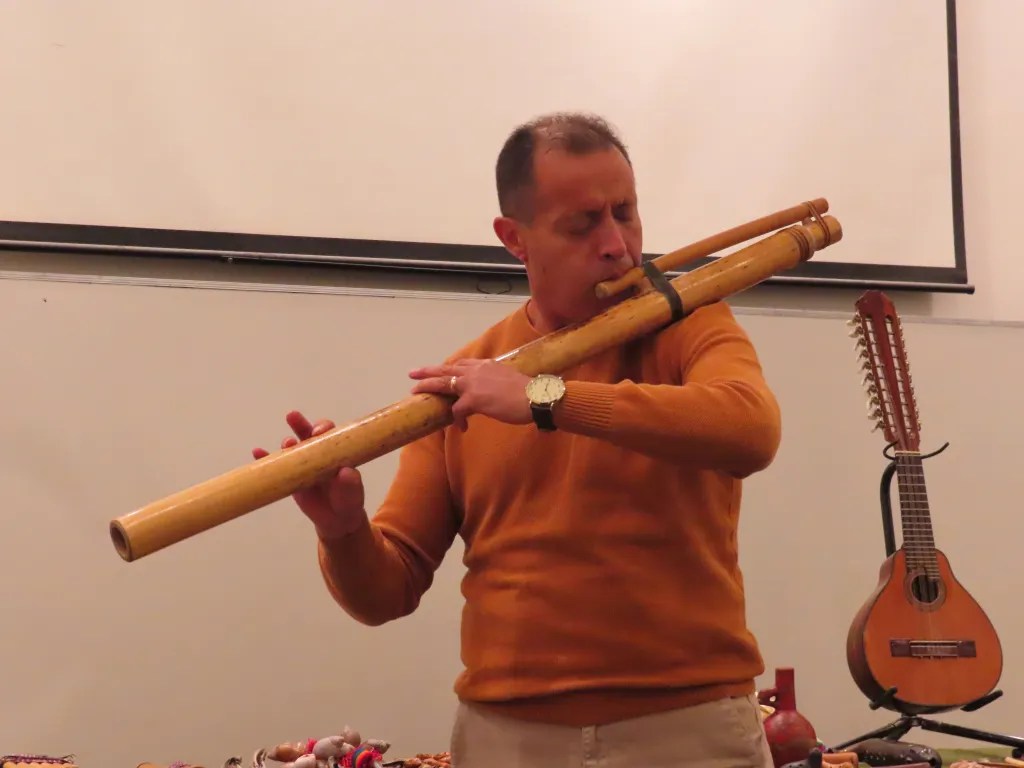
Upon arrival we transferred to our hotel. After check-in we had some time before Gustavo Leon, who was an expert on the history of Inca and Andean musical instruments gave his presentation. His expertise was on native woodwind, percussion, and string instruments.
Below is a picture of the courtyard of our hotel from our room. We opened our window into the courtyard to get some air flowing because our room was warm and there wasn’t any air conditioning. Unfortunately it was still warm and noisy!
When it was time for our lecture with Gustavo, we met in a meeting room and he had his collection of native and ancestral musical instruments. He was a native of Cusco and he had done research and preservation of Peru’s Andean music. He focused on the origins of the music. He was very talented! He demonstrated and played the instruments for us. We were impressed by his collection and his playing ability.
The back was an armadillo shell
After the music demonstration a group of us walked with Victor, our Group Leader, to the Belmond Monasterio Hotel. It was a 5-star hotel with incredible artwork and had a beautiful chapel. It was a monastary in the 1600’s. It’s a national historic monument and was originally built in 1592. After an earthquake did extensive damage in 1650 restoration was done and the chapel was added. In 1965 it was remodeled as a hotel.
Entrance to the hotel and the chapel
Below was a picture of the hotel’s courtyard. In the center was a 300 year old Cedar tree and its surrounded by stone cloisters and religious artwork.
We spent some time in the Chapel of San Antonio Abad. It was a great example of gold leaf style art. The chapel was gorgeous.
Dinner was on our own this evening. One of our fellow traveler friends, Roseanna, knew that the restaurant Uchu was owned by a woman from Lancaster, OH. Lancaster is about an hour from where we live and also was Roseanna’s hometown! We decided to try the restaurant. The food was delicious but unfortunately when we talked to the manager, he let us know that we missed the owner, she was traveling. He was kind and sent us a complimentary olive appetizer!
After our delicious meal we walked back to the hotel. The plaza was still very busy!
As we were walking the moon was shining brightly! The moon was almost full.
This morning we met our Road Scholar group leader Victor. There were 18 of us travelers in our group. We already knew Kathy (from Colorado) that we got to know on our Galápagos Island tour with Road Scholar and Roseanna (from Minnesota) that we got to know on our Road Scholar New Zealand/Australia trip. It was great that we could meet up and travel together in Peru. The fourteen others in our group were great and our group got along well.
After our introductions, we had a speaker, Ricardo Bohl Pazos, who was a geographer. His lecture was “An Overview of Peru”. In the region of Lima, there were 50 districts and 50 mayors. Peru has over 300 volcanoes and 4 are active. He was very interesting.
Ricardo Bohl Pazos, Geographer in Peru
Our next activity was to board a bus for a tour of the city with our local guide Claudia.
Claudia, our local Lima guide
We visited a local fish market and walked out on the pier in Chorrillos, which is another district of Lima.
Fish market entrancevariety of fishFish Market Pelicans hanging outPeruvians on the beach and in the waterThe Pierview from the pierMany boats in the bay
Our tour also stopped at the archaelogical site that we toured yesterday, Hauca Pucllana! Claudia led us through the site but it was a quick overview. We were very glad we took the tour yesterday where we climbed to the top and also visited the entire area. After our quick tour we ate lunch at the restaurant that looks over the site. The Huaca Pucllana Restaurant served us a Pisco Sour, the classic Peruvian cocktail. As an appetizer we had ceviche which was a traditional dish in Peru. The main course was beef tips, fries, and rice. We learned that most Peruvian meals are served with two starches! This was true almost everywhere we ate local food. The dessert was caramel cheesecake but when you must eat gluten free, my dessert was ice cream.
Our lunch viewPisco SourCeviche
After lunch we rode the bus to the historic downtown area of Lima. We walked to the Plaza de Armas which was Lima’s main square. Off of this square was the presidential palace, the cathedral, the municipal palace and private colonial buildings. This square dates to the 16th century.
Looking across the square.The Presidential PalaceColonial building along the squareThe Cathedral The bronze fountain in the center of the square.
We visited the Cathedral of Lima that was on the square. It was a Roman Catholic cathedral and it was built between 1602 and 1797. Francisco Pizarro founded Lima and set aside land for the church. The current cathedral was the third built on this site.
In the late 1800s the remains of Francisco Pizarro were moved to the cathedral and placed in one of the chapels in the church.
We got to visit one of the mansions in the historic area of Lima. The Aliaga family owned this beautiful home since the 16th century! It was the oldest dwelling in the Americas that has been home to the same family for 17 generations! Earthquakes have caused the family to do some rebuilding over the years. This mansion was gorgeous.
Entrance to the mansionThe only air and light is from the high windowsFamily portrait
The home also had secret passageways.
Door to the secret passageway.Secret passageway in the home
As we walked around the town, we came across a Picarones stand. Some of our group wanted to try these. They said they were very good. The Picarones looked like doughnuts. The main ingredients were squash and sweet potato. They are fried in oil and served with syrup made from charcaca (an unrefined sugar base).
Picarones Stand
Our group tasting the Picarones.
Sites as we walked through downtown Lima.
Santo Domingo was a Dominican convent with a pink bell tower. It was an historic religious site that we toured. It had a large courtyard that was lined with Baroque paintings and vintage Spanish tiles (from the 17th century). The monastery was well preserved.
First courtyardSecond floor wooden balconyPink Bell tower in the backgroundSpanish tilesSanto Domingo
The Chapter house was where the friars gathered to solve their problems and choose their authorities. It also was the place where the University of San Marcos which was the first Peruvian university and the oldest university in the Americas! It was founded in 1551.
Santo Domingo’s Chapter room
We also visited the monastery’s library. It contained over 25,000 antique texts.
In the library in a case was a book written on the 6th anniversary of Dante Alighieri’s death. He was an Italian poet, writer and philosopher who died in 1321! He was best known for La Commedia or The Divine Comedy!
This evening we had dinner at a local restaurant called La Tiendecita Blanca. The bartender demonstrated how to make the Peruvian Pisco Sour which was also served to us!
This morning we began our day walking to the Huaca Pucllana. Today we took a tour of the area with our guide Percy.
Percy, our guide
The tour lasted about an hour and a half. Our guide was very knowledgeable. This temple was built before the Incas. It was a Lima civilization temple, dating from around 500 AD. The clay/mud blocks were placed vertically with space in between because of earthquakes. It was made up of million of these adobe bricks. It once served as an administrative center and a pre-Inca ceremonial site.
We were amazed at the advanced engineering techniques used so long ago! Peru sits on the “Ring of Fire”, an area where many volcanic eruptions and earthquakes happen, so tremors occur constantly but many you don’t even notice.
Huaca Pucllana
This area was mainly forgotten. You could still see the dirt hill that covered the site before excavation began.
The uncovered area of Huaca.
The beginning of restration, investigation, and preservation began in 1981 by Dr. Isabel Flores Espinoza and her team and in 1984 it became a cultural heritage site. The Peruvian government has made the necessary preservation efforts to keep the Huaca intact for years to come! It was now a third of its original size, only 15 acres. Due to the rapid expansion and urbanization of the area in the 1900’s that is why it was much smaller.
The city surrounded the site.Buildings all around!
Archeologists were still working! Our visit on day 2 showed them busy working. You can look at that post to see the excavations still being uncovered!
Its pyramid shape was solid not hollow like the pyramids built in Egypt. The Wari culture took over this site around 700 AD and for them it held significance primarily as a burial site for its nobility. Archeologists found an intact tomb in 2008 that held three people, 2 adults wearing masks and a sacrificed child. Below was a replica of the tombs that were found.
Explanation of how the Wari’s buried the individuals.
Other areas for gatherings/meetingsDepicting religious ceremonyDepicting how it was builtDepicting clay pot offeringsGraves found of Chinese immigrants
In the museum on the grounds we saw some original pottery that was found in the area.
We walked over to the Ricardo Palma house museum. He lived in this home for a long time. He was a famous writer who was noted for creating the genre called tradición which is a combination of history and fiction anecdotes. Unfortunately when we arrived the museum was closed for remodeling. We were disappointed but we did find a statue of him.
Ricard Palma Statue
We walked over to Kennedy Park and looked at all of the art displays by local artists and nearby there were many stalls of various products. We also noticed there were many shoe shine stations. It was popular!
Some of the art for saleShoe shine stationsSome sort of card trading
After lunch we walked down by the ocean to Larcomar which was a shopping area for locals and tourists. It was quite busy.
Larcomar Shopping Center
For dinner we walked to a local restaurant called Veda. It was great because the restaurant was a dedicated gluten free establishment.
After our excellent dinner we walked back to our hotel and we read our Road Scholar information sheet because we join the tour tomorrow morning!
This morning we were down in the lobby of our hotel by 4:45 AM for our pick-up for our tour of Ballestas Islands and a visit to the Paracas National Reserve. It turned out to be a private tour with our guide, Junior, and our driver Antonio. Antonio did not speak much English but Junior spoke English very well.
Junior, our guide for the day
We’ve been looking forward to this tour because we will see Humboldt penguins. It would be our 11th out of 18 penguin species that we’ve seen in their natural habitat!
Our driver headed south for our first stop which was our boat ride out to the Ballestas Islands. It was about a four hour car ride. We traveled on the Pan American Highway for quite awhile. This road stretches and connects over 19,000 miles from Ushuaia, Argentina to Prudhoe Bay, Alaska. The road was interesting in places because when we passed through a town, there would be “speed bumps” and crosswalks for people to cross the four lanes. It seemed very dangerous to us but the locals seemed to be used to it.
This is an example of the “speed bump” and crosswalk!
We arrived in Paracas where we would catch our boat that would take us to the uninhabited Ballestas Islands. It was comprised of rocky islands and the Humboldt current was great for the marine life to thrive there. Its cold current pulls up water from the ocean floor, also nutrients and lower temperatures. This made it great feeding for the marine life around there.
Paracas is on the west coast of Peru. We were on one of the first boats over to the Islands. Junior, our guide, made sure we got on the boat, in the middle, and on the left side!
Paracas BayParacas Bay
On our ride to the islands, we saw the Paracas Candelabra or it was also called the Candelabra of the Andes. This was a prehistoric geoglyph found in the Pisco Bay. Its origin is still unknown. Carbon dating was done on artifacts found near this giant geoglyph that dated back to 200 BCE but there wasn’t any clue as to why it was made. It was etched two feet into the petrified sand on the hill and stood almost 600 feet from top to bottom.
Paracas Candelabra
Our view of the Ballestas Islands as we arrived in our boat.
Approaching Ballestas Islands
All the dots you see on the hillside are birds! It was a blanket of birds.
Birds are everywhere!
Once we arrived to the islands we saw the South American Sea lions. Of the sea lions we saw there was one LARGE male! The male had a giant, maned head like a lion!
Male Sea lion
Of course, it was incredible to see all of the birds but our favorite was the Humboldt penguin! The Humboldt penguin adult was about 26 inches tall and weighed about 10 pounds. They are classified as “vulnerable” by the International Union for Conservation of Nature and in 2010 were granted protection under the U.S. Endangered Species Act. You can help the penguins by choosing sustainably harvested fish when you eat seafood!
Humboldt Penguins
We saw the Inca Tern. They are near threatened. They are known for their white mustaches which both the males and the females have. The Inca tern was about 16 inches long and its wing span was about 31 inches.
We saw Peruvian Boobies which were endemic to Peru. They had a white head and neck. There was some white scaling on its darker back.
Peruvian Booby
The Guanays cormorant was also found in the islands. There was a red patch around the eye and its body was black and white. The Guanays were the main producer of guano. For many years the guano found on the Ballestas Islands was used as a fertilizer for plants.
Guanays
Peruvian Pelicans were abundant around the islands. They are “near threatened”. They had a colorful bill and a big whitish upperwing area. Its size was about twice that of a brown pelican.
Peruvian Pelican
Some of the Red-legged Cormorants that we saw were nesting. They are “Near threatened”. They had a distinctive white neck patch, a brightly colored bill, and red legs.
Red-legged Cormorant
We saw a lot of the Kelp Gulls. These gulls were native to the coastlines of the Southern Hemisphere and this gull was one of 55 seagulls! They had a mostly white head and body with dark wings, and a red-tipped bill.
Kelp Gulls
Of course the Peruvian Turkey Vultures were hanging around. Their red necks were visible as they scavenged for fish, eggs, and dead birds/animals!
Peruvian Turkey Vultures
We were out viewing the wildlife around the islands for a little over two hours. When we returned to the docks our guide Junior was there to meet us. He told us that while we were out there on the water a Tsunami warning went off and it freaked him out for a few minutes until he found out that it went off by accident. We were really glad that we had no idea!
Junior walked us to where our driver and the car was located. He suggested we do lunch and our wine tasting experience before we visited the National Reserve. The winery and restaurant were located another hour south of Caracus. Nietto was where we stopped and it was located in the region of Ica. Nietto has been in operation since 1856. It was one of the most visited wineries in the city of Ika. We had a wonderful lunch with our guide and our driver.
After lunch we had a private tour of the winery and its wine making process. After the tour we sampled their wine and pisco, the national drink in Peru. For each of the 7 different wines that we tried, our host had us repeat a Spanish saying before we tried them. Pisco was the last spirit we tried and its alcohol proof was 41%! It was potent. It’s a good thing we had lunch first! The favorite drink with Pisco is the Pisco sour which we tried later in our trip!
After our wine tasting we went to Paracas National Reserve. It was a protected area and there were many archaeological sites in the reserve. It had a dramatic shore line with sculpted rocks from the constant wind and wave action. The Reserve had the desert, the Pacific ocean, and islands.
Entering Paracas National Reserve
The Yacimiento fossil area had many cone-shaped marine fossils. These snails were from about 36 million years ago! It was prohibited to take any of the fossils.
The area was desolate looking and we only saw a few people the entire time we were in the Reserve. The road was hard-packed dirt and very bumpy!
La Catedral was once a sea arch but it was destroyed in the 2007 earthquake. Just parts of the rock were left.
La Catedral
Playa Roja or Red Beach had maroon colored sand that got its color from the erosion of porphyry rocks that were igneous rocks composed of coarse-grained crystals.
Red Beach (Playa Roja)
We stopped and walked part of the beach at Playa Yumaque. During the hot summer days, this beach is popular when La Mina is crowded.
La Mina Beach Area
Playa Yumaque Beach
We saw these “Shantytowns” as we drove along the highway. They basically were made from any materials they could find to use. Some don’t have water or electricity. These had popped up everywhere.
Peru has a large poverty rate. The country was making progress and then the COVID-19 pandemic hurt their progress. Peru had one of the highest death rates due to COVID-19 and due to the lockdowns the country has nearly a third of the total population suffering from monetary poverty. Our guide discussed the impacts on the country.
Our day began in the dark and ended being dropped off at our hotel in the dark. We spent over 15 hours exploring together and we were exhausted at the end of the tour but had a fantastic day learning and seeing more of Peru on our own!
Wednesday, October 5th and Thursday, October 6th, 2022
Wednesday, October 5th, 2022, Day 1
This morning we left our home in the middle of the night because of our 6:40 AM flight to Houston, Texas.
Off on another adventure!
Masks were not required on our flights but we chose to be careful and wore them on our full flight! We have our vaccinations and boosters.
We gained an hour in Houston, Texas and had a layover of almost 6 hours. Dave purchased day passes for the United Club. It was worth every penny! We had comfortable chairs with charging stations, food, and any drink we wanted. Our layover was long enough that we ate breakfast when we arrived and had lunch before we needed to go to our gate to board for our flight to Lima, Peru.
We decided to arrive a few days early so we could visit the Humboldt penguins in their natural habitat. We would join our Road Scholar group on Sunday.
Both of our flights were on time and actually landed early! The time in Peru was the same as Houston. We didn’t need to worry about jet lag!
Landed in Lima
The line wasn’t long to go through Customs so once we had our luggage, we were met by a guide from Holbrook Travel and a driver to take us from the airport to our hotel. With the traffic it was about a 40-45 minute ride.
This picture really doesn’t capture how busy the streets were.
Daniel, our guide, gave us a great narrative about Peru, Lima, and things to do before we join our Road Scholar group on Sunday and Roberto was our driver. At one point we could see the Pacific Ocean as we drove along the highway. When we arrived at out hotel, Daniel made sure we got checked in and had what we needed before he and the driver left. By the time we arrived to our room, we were exhausted and ready to call it a day!
Thursday, October 6th, 2022, Day 2
No alarm was set for today! Although we still woke up early. Today we started exploring the city of Lima. Our first stop was the Park Central de Miraflores. This urban park was named because it is located almost in the center of the city.
Parque Central de Miraflores
We walked through it and then down from it was the Kennedy Park. This park was dedicated to John F. Kennedy. A bust of JFK is located in the park.
Kennedy Parque
These parks are also home to feral cats. The picture below showed just some of the cats!
Many cats make the park their home.
Next, we walked down to the Pacific Ocean. The ocean water temperature was 59˚ F. We still saw many surfers in the ocean catching waves. Most were wearing wetsuits. Brr! We were told this area is great for the beginning surfers. The waves looked big to us but the best waves weren’t around Lima they were located in the northern part of Peru.
Along the ocean were some beautiful parks. The first one we saw was the Parque del Faro.
Surfer MonumentSurfers on their boardsSurfers on their boardsAnother view from the park.View from the parkParque del Faro
The Parque del Amor, was a beautiful park overlooking the ocean with a huge kissing sculpture and beautiful mosaic walls. El Beso, the kissing sculpture, was made by Victor Delfin. It depicted the sculptor and his wife kissing.
El Beso Sculpture by Victor Delfin
After walking along the coast we headed back to our hotel where we had WI-FI to figure out a lunch venue that had gluten free options. We walked to where we thought the restaurant was located. After walking an extra mile and still not finding it, we gave up and ate lunch at a fast food restaurant of all places. We didn’t have WI-FI to search anywhere else! After our “delicious” lunch (insert sarcasm) we walked to the Complejo Arqueológico Huaca Pucllana. It was a huge excavation. It was an ancient adobe and clay pyramid that dates from around 500 AD. It once served as an important ceremonial center for the Lima culture. It was closed today and we plan on taking a tour tomorrow. The restaurant, Huaca Pucllana Restaurant, that looks out over the site was open, so we went in and had a glass of wine.
Complejo Arqueológico Huaca Pucllana
After walking 8 1/2 miles today we were ready to head back to our hotel and rest our tired legs and feet. For dinner we walked to a local restaurant called Joselo By Rigoletto. The food was delicious.
One view inside the restaurantDave’s mealMeal with Gluten free pasta
After dinner we went back to our hotel because we had an early wake up call the next day.
Below were some other sites as we explored Miraflores.