This morning we checked out of our hotel and went to visit Ta Prohm temple. It was used for a couple of scenes in the movie Lara Croft: Tomb Raider with Angelina Jolie.
It was built in 1186 and was a Buddhist temple.
We entered at the West entrance of Ta Prohm and walked to the East Entrance.
As we were walking we passed a group of ants that we were told to not let crawl on us because they would bite. We all steered clear!
The trees(Fig, Banyon & Kapok) and their roots had taken over much of the area and made it creepy as you walked around the grounds.
From tomb raider
Records showed that Ta Prohm was home to more than 12,500 people which included 18 high priests and 615 dancers. More than 800,000 people who lived in the surrounding villages provided services and supplies to the temple.
It was a temple of towers, closed courtyards, and narrow corridors. Many of the corridors were impassable with piles of stone blocks dislodged by the roots of trees.
Bas-reliefs on walls were covered with lichen, moss and creeping plants.
Our guide pointed out that one of the wall reliefs that dinosaurs were carved back in the 12th century! It looked like a type of stegosaurus.
After the temple we visited the Sihanouk-Angkor Museum. The museum opened in 2008.
Norodom Sihanouk-Angkor Museum
A giant Buddha sat at the entrance to the museum.
It had a collection of 274 Buddha statues.
Just one from the Buddha collection.
The “Thousand Buddha” pillar had 1,008 small carvings of Buddha meditating and it covered all four sides.
“Thousand Buddha” Pillar
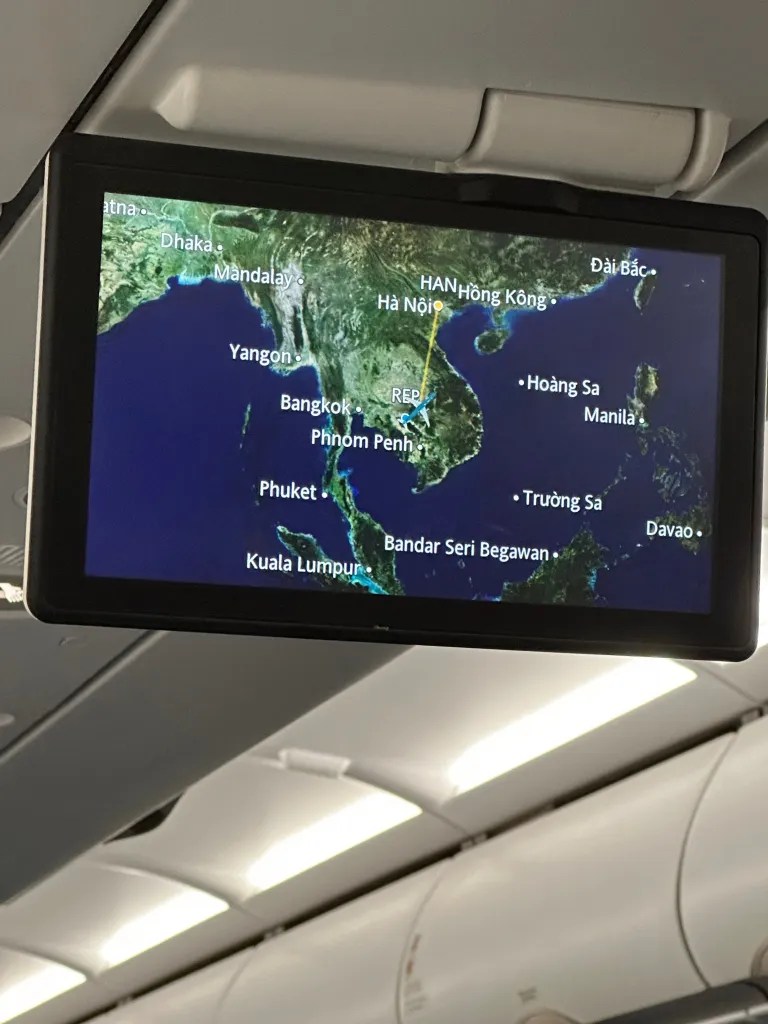
Our next stop was the airport to check-in for our flight to Hanoi. We flew on Vietnam Airlines.
When we landed in Hanoi it was close to 8:00 PM and by the time we picked up our luggage and boarded our bus to the hotel it was after 9:00 PM. The traffic and motorbikes was still very heavy!
This morning we visited a village outside of Kampong Cham.
Some of the children followed us as we walked through the village. They would take turns holding our hands.
Each family had their own rice paddy field.
Rice paddy fields
We visited one village family who supplemented their income by making beaded necklaces, bracelets, sewing small bags, carving wooden utensils. They also let us visit their home upstairs.
The family busy working.We purchased one of their necklaces.Her sewing machine was foot-pedal operated.The family kitchen.Living area was also the bedroom with a mosquito net.glass clothing case with another mattress A separate room for the grown daughters.
In the village was the local store or as our guide called it, “7 Eleven”!
The store’s goodsMore from the storeIn these reused bottles was gas for the motorbikes that they sold.
There also was a traveling market going through the village.
Traveling Market
We visited the Twin Holy mountains, “Phnom Pros and Phnom Srey”. They really are hills but because the area around it is so flat they seem like mountains. We were told the story of the local folklore about how the hills got their names. It was said that a mountain-building competition was organized between men and women to determine who of the two should propose marriage. One mountain was made by men, and the other by women. They had a day to build their hill and whoever built the highest hill would become the winner. The loser would be the one to ask the for the opposite side’s hand in marriage. The competition would end when the Sirius Star rose which was very early in the morning. The women had placed a lantern high so that when the men saw the light, they mistook it for Sirius and stopped working. So the women won. Their mountain is taller and named Phnom Srei (Women’s Hill). The man’s mountain was called Phnom Pros (Men’s Hill). Thus the men still had to ask the woman’s parents for permission to marry.
Phnom Srey (woman hill) and Phnom Pros (man hill) both have pagodas on them but the Phnom Pros was more ostentatious.
In between the two hills was another killing field by the Khmer Rouge. Thousands were massacred here. Phnom Pros from 1975-1979 was used as a detention place for torturing Cambodian people in the Kampong Cham province.
The temple was used as a detention center during the Khmer Rouge.
We spent our time at Phnom Pros. Here we visited the Temple and the Buddha Garden.
Outside of the temple that was used as a detention center.
Steps up the hill to Phnom Pros.
Buddha Garden
The library was located at the base of the hill. The library had four smiling faces.
Library
There were many Macaques monkeys running around. We were told to leave our water bottles on the bus because they would steal them and you don’t want a chance of a scratch or bite.
As we left the hills we saw statues in roundabouts as we were heading back to the riverboat.
1979 liberation from Pal Port
This afternoon we had free time so we walked over to the Pagoda and walked all through the grounds. There were some lavish stupas and we also saw the decorated dragon boat that they use for the Dragon Boat Festival.
Afterward we walked into the local market and looked around.
This evening was the Captain’s Cocktail Party that included a farewell toast because this was our last night on the Viking Saigon. It was hard to believe that we would be disembarking tomorrow.
When we arrived we got off the riverboat and walked into town. As we walked along the road we passed many stupas. A stupa was a place of burial and there were many of various sizes and colors as we went by.
We also passed by a school and the students were interested in us just as much as we were with what they were doing.
In town we got on a tuk-tuk for a ride that was sometimes bumpy, to the Oknha Tey weaving village and it was also known as Silk Island.
Our tuk-tuk and our adorable driver! She didn’t realize we could hear her singing as she drove along!
We saw the silkworms and the process it took to raise cocoons and make silk by using traditional worms. It was a very interesting process.
The silkworms with mulberry leaves
The silkworms lay their eggs in the mulberry trees. The silkworms lived in man-made habitats.
The worms eat a lot of mulberry leaves for a little over a month.
Minea showing us mulberry leaves and its fruit.
Then they begin making a silk fiber to wrap around themselves making a cocoon.
The workers unwrapped the silk fibers from the cocoons by boiling them to loosen the thread.
Raw silk
The threads were then wrapped onto a large spindle. They used natural dyes for most of their silk threads.
Each family had their own foot pedal loom in their home. These villagers also were farmers and fishermen.
The weavers sat at handmade wooden looms. We watched them weave some intricate patterns.
44 rods, peacock design
Below was a quick video showing the process of weaving.
Also, we had time for shopping to help the local economy! I think our group did a great job helping their finances.
One of the village stores.
Back on the riverboat we watched a local take his horses into the river to cool them off and he also washed himself at the same time!
The road that just stopped!
The road just ends.
Late this afternoon we attended a lecture and the topic was “Life at the Mekong River”.
Mammals in Cambodia
Today wasn’t as busy so we enjoyed some time in the afternoon to sit up on the sky deck and read.
This morning we were awake at 4:30 AM and watched ESPN’s game cast of the Ohio State VS Indiana football game. It was their first game of the season. Ohio State won 23-3.
This morning we tried another tropical fruit, longan. The fruit was similar to the lychee. It was native to Asia.
Today we had about an hour drive to the Udon Monastery. We passed the fish market which was busiest at 3:00 AM and 4 PM but we still saw individuals doing business. As we drove along it was so interesting watching the sites.
Fish market
The Vipassana Dhurak Buddhist Center or Udon Monastery complex was huge. The main purpose of the center was to teach Vipassana meditation techniques. Vipassana meant to see things as they really are and came from India’s ancient teachings for meditation. Proper temple dress was required and no hats on the grounds at all so many of our group used umbrellas because the sun was intense today.
Entrance sign
The architecture of the buildings and gardens was beautiful.
We climbed the steps up to the temple and removed our shoes before going inside.
This was the temple we climbed up the stairs for our blessing with the Buddhist monks.
The inside walls and ceiling was covered with colorful panals that told of the Buddha’s life.
We went into the Pagoda for a blessing service from two Buddhist Monks. Instead of water being thrown the monks threw jasmine and lotus petals. When the monks started the blessing chant their voices were so calming even though we had no idea what they were saying.
Just some of the petals that landed on us.
Tony, our program director, took this picture during our blessing.
After the blessing we walked around the area. The monks and the laypeople were getting ready for their meal. The monks eat first in order of their age and then the laypeople.
Preparing for mealtime.A layperson offering alms.
In part of the wooded area were homes of the laypeople who live here. Below were just some of the homes we saw as we walked around. Our local guide told us her grandfather lived in a home like this at a different temple complex and when he passed the family left it for another family to have a place of shelter.
We left the Buddhist Center for a drive to a small village. On our way we crossed the Tonie Sap Lake which was part of the Mekong river system and were on a modern bridge.
Our next stop was Koh Chern which was famous for silver smith and jewelry and was an island in the Tonie Sap Lake. As you cross the bridge the first sight you see was a sitting Buddha!
Sitting Buddha on Koh Chern.
Once we crossed the bridge our bus was too big to go into town so we transferred onto tuk-tuks for the rest of the ride.
The village of Koh Chern silver craft was passed from generation to generation. None of these artisans attended art schools, they learned from family members. Their craft was almost lost during the Khmer Rouge regime. We visited one of the many family-run workshops in the village. The workshop was also part of the family’s home. The family did a demonstration for us.
This afternoon we took a tuk-tuk to the Harvest Square shopping area to visit the Hard Rock Cafe to pick up a guitar pin for Cambodia.
Riding in our tuk-tukThe Hard Rock in Phomh Penh
The same tuk-tuk driver picked us up and on our way back to the riverboat our driver stopped and pointed out sights around the city and then a torrential rain fell and blew in on us. Our driver stopped and put down the clear plastic sides but he was drenched!
Independence Monument- marked Cambodia’s independence from France in 1953.Bronze monument of former King Norodom Sihanouk.Statue of Samdech Chuon Nath, a famous Buddhist Monk in Cambodia.Residence of former Prime Minister, from 1985-2023, Hun Sen Nagaworld, the largest Cambodian casino.
Before dinner we went to a presentation on Cambodia’s modern history by Stephanie. She was a linguist and anthropologist.
After her presentation we had a port talk so we would know the schedule and have time to prepare for tomorrow’s adventures!
We met our Cambodian guide, Minea. She had a great sense of humor and was very informative.
Tony, our program director, and Minea, our Cambodian guide
When we got off the riverboat we were met by cyclos and their drivers. We each rode in a cyclo through the city where our first stop was the Royal Palace.
The traffic as we traveled on the cyclo was busy and sometimes scary.
Walking up to the Royal Palace
One of the entrance gates to the Royal Palace
The Buddhist monks were walking from their school as we were walking up to the palace entrance.
The monks leaving school.
The Royal Palace was a complex of buildings and many of the buildings did not allow photos inside. One of those buildings was the King’s residence. The flag wasn’t flying so he wasn’t there.
Map of the Royal Palace
Our entry ticket
Strict entrance requirementsThis woman had to purchase these huge drawstring pants because she had on shorts!Wrapping the pants around her.
The Silver Pagoda or Temple of the Emerald Buddha was located in the Royal Palace. In 1962 it was rebuilt out of concrete and Italian marble. It was formerly made from wood. It was one of the few buildings that wasn’t destroyed during the Khmer Rouge regime. The Khmer Rouge regime lasted for four years, 1975-1979 and took the power away from the Cambodian people. We learned more about what happened during that time period this afternoon.
Silver Pagoda
It was called the Silver Pagoda because of its floor which was covered with 5000 tiles but when we went in most were covered for protection. No photos were allowed inside.
Throne Hall, used for official ceremoniesImpressive gardens and palm tree
On the Royal Palace grounds was a mini model of Angkor Wat. We visited it later on in our trip. Our guide told us this was a great model to see the full depth of Angkor Wat.
The funeral stupa of King Suramant was located on the grounds as were other deceased royalty. A stupa was a monument that housed the ashes of the person.
Stupa of King Suramant
Walls around the complex contained a mural that depicted the Indian epic poem called Ramayana, or Reamker in Cambodia. The story was too long to retell here. Feel free to look it up online because it was interesting to read about. The mural was created in 1900 and parts had been restored.
Restored panelRestored panelnot completely restoredNo restoration had begun
Have you ever seen a cannonball tree? We did at the Royal Palace. A cannonball tree’s flowers and fruits grow directly from the tree’s trunk. Their name cannonball came from their brown and round fruits.
Cannonball treeCannonball fruit and flower
Each of our cyclo drivers picked us up and took us to the National Museum which was made out of red sandstone. It was the largest museum of cultural history and the finest collection of Khmer sculptures.
The museum suffered a lot of damage during the Khmer Rouge regime. The Australian government and other patrons helped undertake a major remodeling during the 1990s. The Cambodians want to maintain the exhibits in the museum and one was the largest collections of Khmer artifacts in the world.
Near the Royal Palace was the Wat Ounalom. It was one of five original monastries in Phonm Penh. It was damaged during the Khmer Rouge period but had been restored. It was established in 1443 and consisted of 44 structures.
Wat Ounalom
Our cyclos took us back to the boat around lunch time. We saw some more interesting sights as we headed back.
Markets selling wares/food along the road.His business was located in his wagon and he relaxed in his hammock!The truck bed was also his flower/plant shop!
After lunch we had a somber visit to the Tuol Sleng Detention Center Memorial. In 1975 Tuol Svey Prey High School was taken over by Pol Pot’s security forces and it was turned into a prison and was known as S-21 (Security Prison 21). It was the largest center for detention and torture in Cambodia and the most famous.
Pol Pot was the dictator who ruled Cambodia from 1975-1979 and his regime, Khmer Rouge, was responsible for the killing of between 1.5 and 3 million people. They created 189 prisons.
Between 1975 and 1978 over 20,000 people from S-21 were taken to the Killing Fields of Choeung Ek. The Khmer Rouge kept meticulous records of their torture. Each prisoner was photographed when they arrived to S-21 and sometimes after they were tortured! The museum had these photos displayed.
Only 7 prisoners were alive when Phnom Penh was liberated by the Vietnamese army. Two of those survivors, Chum Mey and Bou Meng were still alive and they were at S-21 promoting their first-hand accounts of their prison time!
Our last stop was to one of the Killing Fields, Choeung Ek Genocidal Center.
It was here that the Khmer Rouge regime killed thousands of people.
The memorial with glass sides houses skulls froj victims.There were 5,000 skulls placed in thes memorial of executed victims.
We purchased a lotus flower to place in the memorial urn.
They saved bullets by doing it in the fields and most were hit in the back of the head or swords were used and the victims were then mass buried in shallow graves. We walked through the memorial.
At least 20,000 Cambodians were killed here! Our guide explained that the tree with all the bracelets was where the Khmer Rouge killed small children by beating them against the tree. She visited here on a school field trip and she was very emotional telling us about what happened at this tree.
It was a somber ride back to our riverboat and everyone needed time to process the atrocities of what we heard and saw this afternoon. We were warned it would be an emotional excursion.
We ended the evening on a high with a performance by Cambodian children of traditional folk dances. The youngest performer was four years old. He was a monkey!