This morning we checked out of our hotel and went to visit Ta Prohm temple. It was used for a couple of scenes in the movie Lara Croft: Tomb Raider with Angelina Jolie.
It was built in 1186 and was a Buddhist temple.
We entered at the West entrance of Ta Prohm and walked to the East Entrance.
As we were walking we passed a group of ants that we were told to not let crawl on us because they would bite. We all steered clear!
The trees(Fig, Banyon & Kapok) and their roots had taken over much of the area and made it creepy as you walked around the grounds.
From tomb raider
Records showed that Ta Prohm was home to more than 12,500 people which included 18 high priests and 615 dancers. More than 800,000 people who lived in the surrounding villages provided services and supplies to the temple.
It was a temple of towers, closed courtyards, and narrow corridors. Many of the corridors were impassable with piles of stone blocks dislodged by the roots of trees.
Bas-reliefs on walls were covered with lichen, moss and creeping plants.
Our guide pointed out that one of the wall reliefs that dinosaurs were carved back in the 12th century! It looked like a type of stegosaurus.
After the temple we visited the Sihanouk-Angkor Museum. The museum opened in 2008.
Norodom Sihanouk-Angkor Museum
A giant Buddha sat at the entrance to the museum.
It had a collection of 274 Buddha statues.
Just one from the Buddha collection.
The “Thousand Buddha” pillar had 1,008 small carvings of Buddha meditating and it covered all four sides.
“Thousand Buddha” Pillar
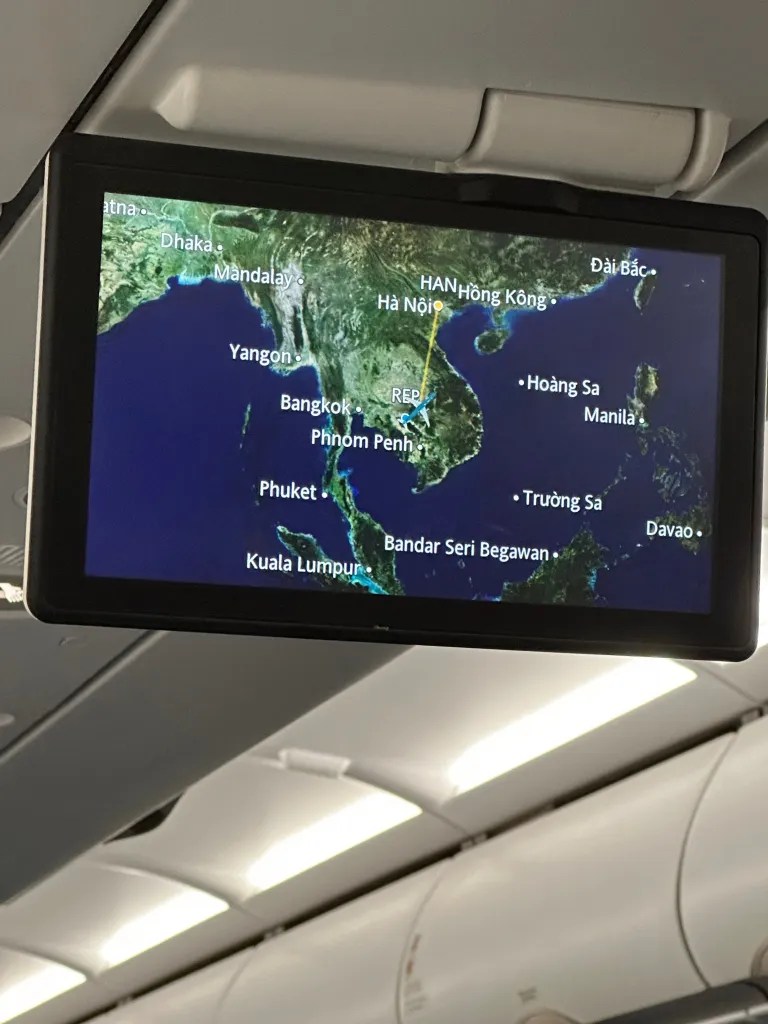
Our next stop was the airport to check-in for our flight to Hanoi. We flew on Vietnam Airlines.
When we landed in Hanoi it was close to 8:00 PM and by the time we picked up our luggage and boarded our bus to the hotel it was after 9:00 PM. The traffic and motorbikes was still very heavy!
This morning we visited a village outside of Kampong Cham.
Some of the children followed us as we walked through the village. They would take turns holding our hands.
Each family had their own rice paddy field.
Rice paddy fields
We visited one village family who supplemented their income by making beaded necklaces, bracelets, sewing small bags, carving wooden utensils. They also let us visit their home upstairs.
The family busy working.We purchased one of their necklaces.Her sewing machine was foot-pedal operated.The family kitchen.Living area was also the bedroom with a mosquito net.glass clothing case with another mattress A separate room for the grown daughters.
In the village was the local store or as our guide called it, “7 Eleven”!
The store’s goodsMore from the storeIn these reused bottles was gas for the motorbikes that they sold.
There also was a traveling market going through the village.
Traveling Market
We visited the Twin Holy mountains, “Phnom Pros and Phnom Srey”. They really are hills but because the area around it is so flat they seem like mountains. We were told the story of the local folklore about how the hills got their names. It was said that a mountain-building competition was organized between men and women to determine who of the two should propose marriage. One mountain was made by men, and the other by women. They had a day to build their hill and whoever built the highest hill would become the winner. The loser would be the one to ask the for the opposite side’s hand in marriage. The competition would end when the Sirius Star rose which was very early in the morning. The women had placed a lantern high so that when the men saw the light, they mistook it for Sirius and stopped working. So the women won. Their mountain is taller and named Phnom Srei (Women’s Hill). The man’s mountain was called Phnom Pros (Men’s Hill). Thus the men still had to ask the woman’s parents for permission to marry.
Phnom Srey (woman hill) and Phnom Pros (man hill) both have pagodas on them but the Phnom Pros was more ostentatious.
In between the two hills was another killing field by the Khmer Rouge. Thousands were massacred here. Phnom Pros from 1975-1979 was used as a detention place for torturing Cambodian people in the Kampong Cham province.
The temple was used as a detention center during the Khmer Rouge.
We spent our time at Phnom Pros. Here we visited the Temple and the Buddha Garden.
Outside of the temple that was used as a detention center.
Steps up the hill to Phnom Pros.
Buddha Garden
The library was located at the base of the hill. The library had four smiling faces.
Library
There were many Macaques monkeys running around. We were told to leave our water bottles on the bus because they would steal them and you don’t want a chance of a scratch or bite.
As we left the hills we saw statues in roundabouts as we were heading back to the riverboat.
1979 liberation from Pal Port
This afternoon we had free time so we walked over to the Pagoda and walked all through the grounds. There were some lavish stupas and we also saw the decorated dragon boat that they use for the Dragon Boat Festival.
Afterward we walked into the local market and looked around.
This evening was the Captain’s Cocktail Party that included a farewell toast because this was our last night on the Viking Saigon. It was hard to believe that we would be disembarking tomorrow.
This morning we were awake at 4:30 AM and watched ESPN’s game cast of the Ohio State VS Indiana football game. It was their first game of the season. Ohio State won 23-3.
This morning we tried another tropical fruit, longan. The fruit was similar to the lychee. It was native to Asia.
Today we had about an hour drive to the Udon Monastery. We passed the fish market which was busiest at 3:00 AM and 4 PM but we still saw individuals doing business. As we drove along it was so interesting watching the sites.
Fish market
The Vipassana Dhurak Buddhist Center or Udon Monastery complex was huge. The main purpose of the center was to teach Vipassana meditation techniques. Vipassana meant to see things as they really are and came from India’s ancient teachings for meditation. Proper temple dress was required and no hats on the grounds at all so many of our group used umbrellas because the sun was intense today.
Entrance sign
The architecture of the buildings and gardens was beautiful.
We climbed the steps up to the temple and removed our shoes before going inside.
This was the temple we climbed up the stairs for our blessing with the Buddhist monks.
The inside walls and ceiling was covered with colorful panals that told of the Buddha’s life.
We went into the Pagoda for a blessing service from two Buddhist Monks. Instead of water being thrown the monks threw jasmine and lotus petals. When the monks started the blessing chant their voices were so calming even though we had no idea what they were saying.
Just some of the petals that landed on us.
Tony, our program director, took this picture during our blessing.
After the blessing we walked around the area. The monks and the laypeople were getting ready for their meal. The monks eat first in order of their age and then the laypeople.
Preparing for mealtime.A layperson offering alms.
In part of the wooded area were homes of the laypeople who live here. Below were just some of the homes we saw as we walked around. Our local guide told us her grandfather lived in a home like this at a different temple complex and when he passed the family left it for another family to have a place of shelter.
We left the Buddhist Center for a drive to a small village. On our way we crossed the Tonie Sap Lake which was part of the Mekong river system and were on a modern bridge.
Our next stop was Koh Chern which was famous for silver smith and jewelry and was an island in the Tonie Sap Lake. As you cross the bridge the first sight you see was a sitting Buddha!
Sitting Buddha on Koh Chern.
Once we crossed the bridge our bus was too big to go into town so we transferred onto tuk-tuks for the rest of the ride.
The village of Koh Chern silver craft was passed from generation to generation. None of these artisans attended art schools, they learned from family members. Their craft was almost lost during the Khmer Rouge regime. We visited one of the many family-run workshops in the village. The workshop was also part of the family’s home. The family did a demonstration for us.
This afternoon we took a tuk-tuk to the Harvest Square shopping area to visit the Hard Rock Cafe to pick up a guitar pin for Cambodia.
Riding in our tuk-tukThe Hard Rock in Phomh Penh
The same tuk-tuk driver picked us up and on our way back to the riverboat our driver stopped and pointed out sights around the city and then a torrential rain fell and blew in on us. Our driver stopped and put down the clear plastic sides but he was drenched!
Independence Monument- marked Cambodia’s independence from France in 1953.Bronze monument of former King Norodom Sihanouk.Statue of Samdech Chuon Nath, a famous Buddhist Monk in Cambodia.Residence of former Prime Minister, from 1985-2023, Hun Sen Nagaworld, the largest Cambodian casino.
Before dinner we went to a presentation on Cambodia’s modern history by Stephanie. She was a linguist and anthropologist.
After her presentation we had a port talk so we would know the schedule and have time to prepare for tomorrow’s adventures!
This morning we boarded a coach for a tour of the Grand Palace and then on to Wat Pho.
To visit the Grand Palace, the entrance requirements were strictly enforced! As you enter, the first stop was to make sure you were dressed appropriately! No shorts, no shoulders showing, no flip flops, no deep cleavage, no short or see-through tops, no torn or tight pants, and no bike pants.
The white fence that surrounded the Grand Palace.
The Grand Palace was built in 1782. We walked around the grounds and the temperature was in the mid-80’s but the “real feel” was in the 90’s and it was only 9:00 AM! Pete and Jenny, our Bangkok guides explained the history of the palace and the Kings. Pete shared that the movie, The King and I, was banned in Thailand because most of the film had hisotrical inaccuracies.
The Grand Palace complex was built to serve as the royal residence and administrative offices and the Temple of the Emerald Buddha. The current king is Maha Vajiralongkorn since 2016. He also was the wealthiest of all monarchs.
The amount of buildings in the palace complex numbered over 30! It was massive and beautiful.
Pete showing us how to fold a lotus flower.
The temple with the Emerald Buddha was beautiful. No photos were allowed inside because their king visits often and the palace security doesn’t allow them for his protection. But you could take a photo looking in from the outside.
Emerald Buddha
As we were getting ready to leave we saw their version of the changing of the guard.
Changing of the guard
Our next stop was Wat Pho. This was another temple. Again no bare shoulders or knees showing, but it wasn’t quite as strict as the Grand Palace. Our shoes came off and left outside before entering. Here we saw the reclining Buddha which was 151 feet long and covered in gold leaf. It was located about ten minutes from the Grand Palace.
The reclining Buddha’s feet were 16 1/2 feet long and decorated with mother of pearl-of-pearl which were characteristics of the Buddha.
Bottom of reclining Buddha’s feet
For good luck one could purchase a bowl of coins and then drop one in each of the bronze bowls that line the length of the walls. This money went toward helping the monks renovate and preserve Wat Pho.
We had a break for lunch back at our hotel. When we went to our room we had another fruit to try, a Chinese pear. It was very tasty!
This afternoon we met Jenny for an afternoon tour of Chinatown, the Flower and Vegetable Market, and a visit to the Temple of the Golden Buddha.
Our first stop was Sukhothai Traimit, where the Golden Buddha was located in Chinatown.
It was the largest Golden Buddha image in the world. It was made of solid gold! It was 12 feet 5 inches in diameter and was 15 feet 9 inches tall. It weighed about 5.5 tons! It was valued over 35.3 million dollars!
What’s fascinating about this solid gold Buddha was that it was covered in plaster to protect it from invading armies. It was over 700 years old. When it was moved to Traimit, it was accidentally damaged and some of the plaster came off. The movers noticed something that was shiny. After careful inspection they found that it was made of solid gold.
When we went in to see the Golden Buddha we were dressed appropriately and our shoes were left outside.
Monks are permitted to get much closer to Buddha.
We walked through Chinatown. The streets and sidewalks were very crowded and Jenny told us this was nothing compared to how crowded it would get in the evening! As we walked the area we saw many gold shops, open/street vendors and restaurants that opened out into the sidewalk.
The flower and vegetable market was our last stop this afternoon. These markets were opened 24 hours! They had a day shift and a night shift. The prices of the flowers were cheap by comparison to flower prices at home.
20 Baht is about 56 cents
We also couldn’t get over the size of the carrots and how nice the corn was, as well as the other vegetables. It all looked delicious!
It was a sweaty but a good afternoon. Another shower because we were drenched!
In the evening we walked over to Iconsiam, the shopping mall. We stopped and took some photos of our hotel from the street.
On the sixth floor was a terrace restaurant with incredible views of Bangkok and the river. The bad thing with the restaurant was that for gluten free options there was on choice, fried rice. It was pretty dry because they didn’t have any gluten free soy sauce.
Outside of IconsiamThe shuttle to our hotel.
When we arrived in the lobby of our hotel, an artist was creating a beautiful fruit carving!
We went to bed on the early side because tomorrow we needed to be up by 5:30 AM. We would be saying goodbye to Bangkok.
Our hotel room looked over the Chao Phraya River. This river flowed through Bangkok and then into the Gulf of Thailand. It was important for the people of Thailand because of its importance for transportation.
The river view from our room.The view of part of the pools from our room.The hotel shuttle, a boat!
Breakfast was included with our stay. The buffet was huge with so many choices!
A couple of the breakfast buffet stations!
We met our Viking guides, Pete and Julie (their American names because their Thai names were very long) in the hotel lobby as well as the others in our group for a long-tail boat ride to Wat Arun-“Temple of Dawn”.
You could see our hotel in the background as we boarded our boat.
Riding our long-tail boat to Wat Arun.
It was a Buddhist temple complex so appropriate dress was required, no knees showing and shoulders covered. The temple dress was not like the cathedrals in Europe where one could cover your shoulders with a shawl or scarf. It was not acceptable here. We were not aware of this so it made an impact in what we had packed, especially as the trip continued. Also it was too hot to wear a sweater over your shoulders. It was shared consistently by all of our guides that SE Asia has three seasons: hot, hotter, and hottest! We visited during the “hotter” rainy season!
Wat (a Buddhist monastery or temple) Arun (named for the Hindu god of the dawn, Arun) was located on the west ban of the Chao Phraya River. It was known for its central spire which was 250 feet high! Some considered it the Eiffel tower of Thailand! It was built in the mid 1800’s but a temple existed on this site since the 16th century. The spire was decorated with tiny pieces of colored glass and Chinese porcelain with beautiful patterns.
viewing Wat Arun from the river.The entrance to Wat ArunThe beautiful spire at Wat Arun.
After climbing as high as we were permitted and looking around we then went into the hall where a Buddhist monk was giving blessings. Shoes were left outside. We were blessed by the monk with holy water and he tied a simple string bracelet with some beads which was to bring us health and good luck!
After touring the temple complex we got back in our long-tail boat and toured through a Khlong, which was the word for canal. On our ride in one of the khlongs we saw a 300 foot Buddha at Wat Muang Temple! It was the biggest Buddha in Bangkok. It was made of cement and painted gold. It was started in 1990 and was finished in 2008.
This was the closest we could get on our boat.
From our boat we saw several Asian water monitors sunning themselves.
Asian Water Monitor
The canals had many large catfish! Pete gave us each a roll to break up and throw into the river so we could see them.
Feeding the catfish!
We saw homes along the canal and passed other boats with locals carrying their wares. There was a lot to observe as we slowly rode along the canal.
Entrance into the canal.Merchant with her items for saleA FAST long boat, look at that engine!Homes along the canalMore homes.Another home.
Back on the river we observed skyscrapers and buildings as we returned to our hotel.
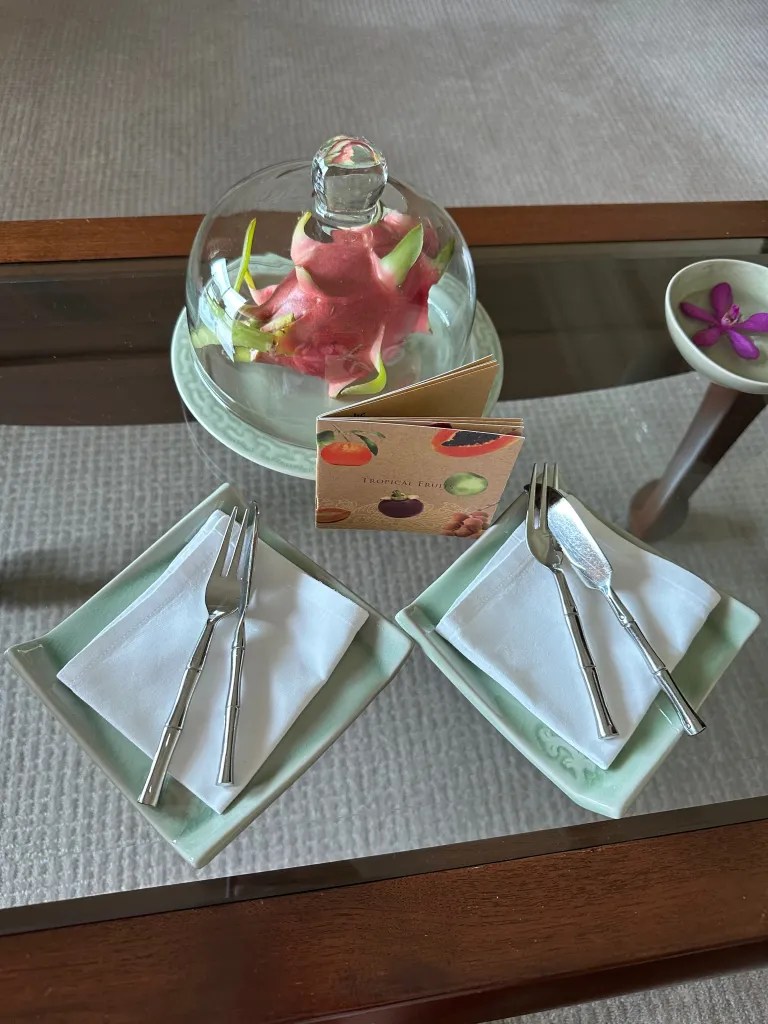
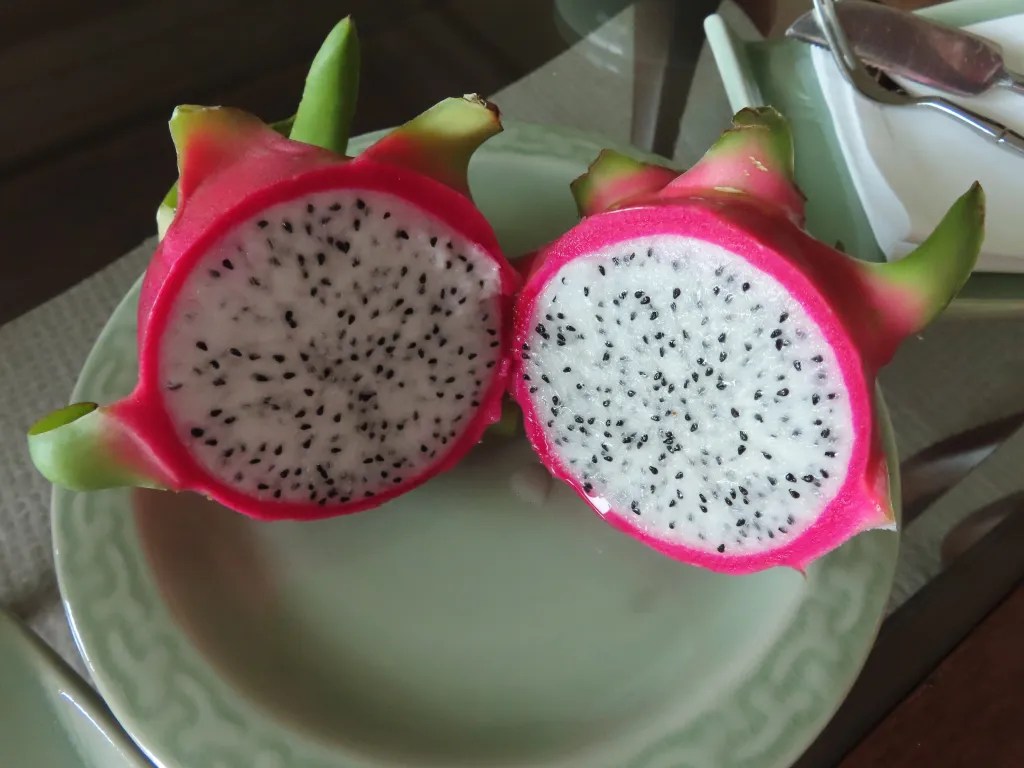
After our morning tour we dropped some of our belongings in our hotel room. Our room had been cleaned and we had another fresh fruit with serving ware on our table. When we arrived yesterday or rather very early this morning we had some delicious grapes in our room. Today’s fruit was Dragon Fruit. There was a book with all the different fruits and a description of them. It was delicious!
After our snack we went to the hotel boat shuttle that would take us to Iconsiam, a beautiful shopping mall with luxury stores and on the first floor there were shops with food stalls. We explored many of the levels but not all because this mall had over 7,000 shops and 100 restaurants! Below are some pictures from the mall.
Food MarketDave had some spring rolls!
After walking around we went back to the hotel because we both were still tired from our lack of sleep and tomorrow would be another early morning!