France Odyssey: Seine River, Reims, & Paris Day 6

We were on the road early because we had a full day ahead of us.

Sunrise along the Seine River

Today we visited visited some of the Normandy beaches. We visited this area on a trip in 2019 and spent a lot of time at all of the D-Day beaches. This time it was just a day trip but it was worth visiting again. A second visit gave us new experiences and insights.

Our first stop was Pointe Du Hoc. Pointe Du Hoc had cliffs(100-120 feet high) that overlooked the English Channel and Omaha Beach.

During WWII this area was a stronghold of the Germans. On June 6, 1944 the US Army Rangers scaled the cliffs to capture this position. You could see remains of German bunkers and machine gun posts.

The French erected this monument on a cliff here to honor the American Second Ranger Battalion.

Pointe du Hoc Ranger Monument

On the center of Omaha Beach there were two memorials. On the left was the Les Braves which consisted of three elements: 1. the Wings of Hope, 2. Rise, Freedom, and 3. The Wings of Fraternity. On the right was a stone monument to the Allies.

Walking along Omaha Beach

We also saw a memorial for the 29th Division at Omaha Beach of a soldier carrying a wounded comrade on D-day.

Memorial at Omaha Beach of Soldier helping a wounded soldier.

The National Guard Association memorial was important to some of our veterans who served with the National Guard more recently. The National Guard memorial was also located at Omaha beach on top of a German bunker! It commemorated the actions of the National Guard during WWII.

National Guard Memorial

After Omaha Beach we visited the Normandy American Cemetery that overlooked Omaha Beach.

The cemetery was dedicated in 1956 and was located in Colleville-sur-Mer, France. It was built on the temporary American St. Laurent cemetery. It was established by the U.S. First Army on June 8, 1944 and was the first American cemetery on European soil in WWII. The cemetery covered 172 1/2 acres and contained the graves of 9,837 military dead. Most of them lost their lives on the D-Day landings. The cemetery also had a wall of the missing with 1,557 names inscribed on it. A rosette marked by a name meant they were recovered and identified.

The statue by Donald De Lue was made from bronze and was called “Spirit of American Youth Rising from the Waves”.

Across from the statue one of our travelers in our group was a retired Major General and she presented the veterans in our group with a challenge coin. She also presented those that served prior to 1973 with a coin.

The Veterans traveling with us. We honored their service!

This time capsule was buried on June 6, 1969 and will be opened on the 100th anniversary of the allied landings along the coast of Normandy.

Our lunch was served at the L’Albatros Restaurant that was part of the Omaha Beach Golf Club. The La Mer course had each hole named after a liberating American veteran or famous battle. We enjoyed the lunch that was served.

After lunch we visited the new D-Day museum located in Arromanches’ seafront. It was built on the geographical center of the D-Day landing beaches. This museum focused on the D-Day Landings!

We were interested in the Mulberry Harbor and the museum explained it well. Right after D-Day the beach of Arromanches one of two Mulberry harbors was created. It was quite an engineering feat. The pieces to build the harbor were carried over from Britain. This allowed the heavy equipment to be unloaded. Below were models that showed how the harbor would work.

We saw remnants on land and some that were left out from the beach area.

On our way back to the riverboat we passed the Eisenhower roundabout in Bayeux, France. In the center of the roundabout is a memorial dedicated to General Dwight D. Eisenhower, Supreme Allied Commander in Europe.

When we returned back to the riverboat we had a little time to walk into the town of Caudebec-en-Caux.

In 1940, the Germans wanted to bomb the ferries crossing the river but missed and instead hit cars waiting to cross on the ferry. The cars caught on fire and the fire spread quickly and 80% of the town was destroyed because most of the buildings and homes were made of wood. The Church of Notre-Dame of Caudebec-en-Caux survived. It dated from the 15th and 16th century.

The church was listed as a historic monument since 1840. The Gothic style had many decorative carvings on the outside of the church. We were unable to visit inside because it was late in the day and all the doors were locked.

The sun was setting so we headed back to our riverboat.

France Odyssey: Seine River, Reims, & Paris Day 5

This morning we arrived in Le Havre, France. It was a major port city in the Normandy region and it was located where the Seine River emptied into the English Channel.

Near our dock we could see the last US Army tugboat that served here from 1944-1946. The boat was now a museum ship.

We rode through the town of Le Havre on our way to Étretat. Le Havre was almost completely rebuilt after WWII. It was the first modern city and one of two post-WWII cities recognized as a World Heritage site by UNESCO. Auguste Perret was the chief architect for reconstruction and used reinforced concrete.

A little over 370 acres of concrete made up the city.

This memorial was to commemorate residents of La Havre who had lost their lives in WWI, WWII, wars in Indochina (1946-1954) and Algeria (1954-1962).

The “Catène de Containers” art installation was constructed from shipping containers by Vincent Ganivet for La Havre’s 500th anniversary.

Catène de Containers

The Le Havre Cathedral was one of the few buildings that survived the bombings of WWII. The main facade was Baroque and the bell tower was from around 1520.

The Cathedral was built in the 16th-17th century and was only partially damaged during WWII.

This morning our first stop was Étretat. It was a seaside town that was known for its white cliffs which many impressionist painters had painted. The most famous was Claude Monet.

Erosion created arches and the needle-like structure. We had time to climb the east side or west side of the beach. We climbed the west side path that also lead to an 18-hole golf course. The views were beautiful from the top of trail.

Click through the slideshow to see the gorgeous cliffs, beach, and town!

The old wooden Covered Market was built in 1927 for fish stalls. Today there were shops inside.

Old Covered Market

Etretat had old medieval half-timbered homes.

Maurice Leblanc’s home was built around 1850. Maurice was a French novelist. He called the home “Clos Lupin” after his fictional character from his popular short stories that began in 1905. The home was confiscated by the Germans during its occupation of Etretat. The home eventually was purchased by his granddaughter and she turned it into a museum.

Our next stop was Honfleur, France.

Le Vieux Bassin, the old port was a focal point of this beautiful city. It was lined with distinctive tall, narrow, timber-framed, and slate-clad townhouses built from the 16th to 18th century.

Six story townhomes

Sainte Catherine Church was the largest wooden church in France. Its bell tower was separate from the main building.

The inside of the church.

The La Lieutenance was the last bastion of medieval Honfleur.

La Lieutenance

We walked past the town hall.

Honfleur Town Hall

We saw the Roncheville manor which once was the residence of the governors of Honfleur. We walked into the Courtyard of the Roncheville Manor.

Roncheville Manor
Closeup of the entrance to the courtyard of the manor.
the courtyard of the manor

We walked down the Rue des Petites Boucheries. The name of this street dated to the 17th century and was named because it was lined with butchers stalls.

Near the harbour was a beautiful vintage carousel. Four of us rode it and enjoyed our ride!

After our tour of the town we had free time. We walked around the beautiful harbor and then found an outdoor patio for champagne and an afternoon snack. The owner, waitress, and a neighbor child helped us and were so kind and attentive.

Enjoying our champagne!

It was a perfect way to end our time in Honfleur!

France Odyssey: Seine River, Reims, & Paris Day 4

The Amadeus Diamond arrived in Rouen about 8:00 AM.

Rouen, France

Across from our riverboat was the newest area of Rouen and the tall building you see in the picture below was the Archive Tower. It was built in 1965, stands over 300 feet and had no windows.

Archive Tower

Rouen, France was a port city along the Seine and was located about 78 miles from Paris. In 1204 the French captured the city from the Normans. Rouen prospered until the Hundred Years War (1337-1453) and it was taken by Henry V of England. St. Joan of Arc, in 1430, France’s patron saint was imprisoned in a tower in Rouen. She was burned at the stake by the English in the city, in May, 1431 for heresy.

The church above was the E’glise Jeanne d’ Arc. It was completed in 1979 and built in the center of Place du Vieux MarchĂ© (old market). The inside of the church had a beautiful wall of 13 Renaissance stained-glass windows that were from 1520-1530. They were in the Church of St. Vincent in Rouen that was heavily damaged by the Allied strikes in 1944. The windows were stored in a safe location for the rest of the war. Then the windows were used in the Joan of Arc church!

Panorama of the stained glass windows.

Also in the church was a memorial to Saint Joan of Arc.

Also located on the Old Market was the La Couronne restaurant. It was where Julia Child had her first French meal.

La Couronne

On our walk through the city we saw the Gros-Horloge or Great Clock. It houses one of the oldest clock mechanisms in Europe. It was an astronomic clock that sat on a Renaissance arch and it was flanked by a Gothic belfry from the 14th century. The belfry housed the bells that were linked to the clock’s movement. All of this was restored from 1997 to 2006.

The Gros-Horloge and the Belfry

The two faces of the clock displayed 24 rays of sun against a blue starred sky. There were moon phases on the oculus above the face of the clock. Also, a hand showing the week inside an opening at the base of the dial! Since the 1920s the clock was powered by electricity.

The arch below the clock contained bas-reliefs and the center was of Christ as the Good Shepherd.

The narrow streets of the old town were lined with half-timbered houses. Some of which date back to the middle ages. The town had about 2000 half-timbered homes which were made with timber posts. It was amazing that this many survived with all the devastation from WWII.

The Gothic style Cathedral Notre Dame de Rouen suffered damage from the Allied bombings that occurred a week before D-day. It was hit by seven bombs.

Rouen Cathedral

It was the highest cathedral in France after the reconstruction of its cast iron spire in 1876. The cathedral became internationally famous because of the paintings of it by Claude Monet who once lived across from the church.

The beauty of the Rouen cathedral continued inside its doors. The mostly Gothic style could be viewed. The right side of the cathedral was destroyed by the Allied bombing but the restoration was amazing!

Below were additional views of the cathedral.

We stopped in the Le Cacaotier, Hubert Masse, Artisan Chocolatier because we were told this shop had the best chocolate. We got some to take back to the riverboat. We enjoyed this delicious chocolate for the rest of our trip!

The Hilliard Area Chamber of Commerce travelers dressed as pirates to “take over the ship” and we took the second captain as hostage. The captain took many pictures and videos. He thought it was great! We had a lot of fun as the other passengers looked on with amusement!

The captain was on the far left and next to him was his second captain and some of our pirates!
The Hilliard Area Chamber of Commerce “pirates”!
The Hilliard Area Chamber of Commerce president captures the second captain!

We did our O-H-I-O in honor of our Buckeyes!

This evening we set sail for our next port Le Havre!

France Odyssey: Seine River, Reims, & Paris Day 3

Over night we arrived at Conflans-Sainte-Honorine which was located 27 miles on the right bank from Paris. This village originally was called Conflans because it was located at the confluence of the Seine and Oise rivers. Sainte-Honorine was added to its name in the 13th century after the female Saint Honorina.

We woke up early and the sun was rising and outside the river looked ominous!

Once the sun was up the river mist cleared and the river and sky looked beautiful.

Conflans-Sainte-Honorine

This morning was a walking tour “Tracing Vincent Van Gogh’s Footsteps” in Auvers-sur-Oise and Auberge Ravoux.

As we were walking into town we were excited to see the Horse Chestnut trees with many of the nuts falling on the ground. To those of us from Ohio we all picked up what we called a Buckeye! They were very similar!

Van Gogh lived here from May 20th, 1890 until July 29th, 1890 when he died from a self-inflicted gunshot wound. He was very productive in the few months he lived here. Some of his best works were painted from this area.

Statue of Vincent Van Gogh

During the time that Van Gogh lived in Auvers-sur-Oise he painted almost 80 works in 70 days. One of his paintings was of the Notre Dame d’ Auvers church. The church was begun in the 11th century from local stone and was added onto in 1170. We visited this church which had a copy of his painting hanging in the sanctuary. This church became infamous thanks to Van Gogh’s painting!

We walked by the stairway that was in Van Gogh’s painting, “Stairway at Auvers”!

Another building that Vincent Van Gogh made famous because he painted it was the Town Hall. What he painted was his view of the Town Hall when he left the Auberge Ravoux which was where he stayed.

We also visited the Auberge Ravoux and the room where Vincent Van Gogh lived and died. He arrived here on May 20th, 1890.

L’ Auberge Ravoux Inn and Restaurant since 1876.

Dave sat at the table in front of the Auberge Ravoux and inside Vincent Van Gogh’s table was near the back of the dining room.

He paid 1 franc a day for room #5 which was a little over 75 square feet and was lit by a sky light. He paid 2.50 francs per day for his meals. We walked up the staircase and saw his little room but no pictures were allowed. Vincent Van Gogh tried to end his life by shooting himself in the chest but made it back to his room and two days later died in his attic room.

Vincent Van Gogh was buried in Auvers Cemetery. Six months later his brother Theo died in the Netherlands at the age of 33. In 1914 his wife had his remains moved so that the two close brothers could be reunited after death! We walked to the Auvers Cemetery and visited their graves.

Entrance to Auvers Cemetery.

The brothers graves were covered in ivy and sunflowers interspersed.

Emile Boggio was another impressionist painter that died at the age of 63 in Auvers-sur-Oise and was buried here.

We walked back into the center of town we passed a statue dedicated to Charles Francois Daubigny. He died in 1878 at the age of 61 and was a French painter. He was known for his landscape paintings and was considered to be an important precursor of impressionism.

Charles Francois Daubigny

We really enjoyed our walk around the town and in Vincent Van Gogh’s footsteps! Back to the boat we went for lunch and our afternoon was free.

Amadeus Diamond

This afternoon we explored the town of Conflans-Sainte-Honorine. We walked up toward the old upper historic center of town.

Homes along our walk.

We stopped at the Saint Maclou Church. It was built between the 10th and 12th centuries and enlarged in the 15th, 17th, and 19th centuries. It had a Romanesque-style bell tower that was topped by a stone spire.

Saint Maclou Church

The relics of Saint Honorina were kept in the Saint Maclou Church. She was the oldest revered virgin martyr of Normandy. It was said that her body was thrown into the Seine near the town of Le Havre and drifted to the site of Conflans-Sainte-Honorine and the town reportedly collected her remains and they buried by the Christian community. Her bones are kept in the church.

Inside the church
A thank you to Sainte Honorina

We walked along the narrow street, Rue de la Tour, and a class of school children on a field trip passed us. Many said hello in English.

Rue de la Tour gave us great views of the rooftops and the Seine River. We also saw the forest of Saint-Germain-en-Laye. This forest had many 100 year old trees and it also was part of the ancient forest of Yveline where many kings of France hunted.

Back down near the river we walked passed City Hall that was finished in 1896.

We looked back up the hill and we could see the Monjoie Tower in ruins. It was part of the medieval castle of Conflans. It was built in the 11th century on the site of a fort that was made of wood.

We set sail around 5:00 PM. We went through a lock before dark.

Tomorrow we visit Rouen, France!

France Odyssey: Seine River, Reims, & Paris Day 1 and 2

Tuesday afternoon we left for the airport. Five of us were traveling together and we were meeting our sixth traveler in Paris! Our flight left Columbus and we arrived at Washington Dulles for our overnight flight to Paris, France.

Ready for our flight from Washington Dulles to the Paris Charles de Gaulle.

We arrived in Paris, got our luggage, and the bus took us to the Amadeus Diamond, our riverboat for the week.

Amadeus Diamond

We left our luggage because the crew wasn’t ready for us to go to our rooms yet. We met our nephew here, our sixth traveler, and he took us to a riverboat cafe down the way so we could get something to drink and a snack while we waited to board the ship. We could see the Eiffel Tower in the distance.

During the evening’s cocktail hour, champagne was served for a Captain’s toast.

During dinner we noticed the Eiffel Tower was lit and sparkling! The video was taken with our iphone.

We celebrated one of our traveler’s birthday after our first dinner on the ship! The restaurant staff brought him a cake and sang to him! It was a great way to finish our first evening on the riverboat!

We were so tired after getting little sleep on the plane we went to our stateroom not long after dinner!

The Magnificent Mekong Day 18 and Day 19

President was flying into Hanoi today so our plans for the day had to be altered due to security and his itinerary. As we were driving along you could see the American flags flying along with the Vietnamese flags.

We were to visit the Ho Chi Minh Complex but we only were able to drive by it.

Ho Chi Minh’s mausoleum was up the hill on the grounds. There already was a line to visit inside where Ho Chi Minh’s body was encased. We were to visit in the afternoon.

We could see the Presidential Palace of Vietnam. Ho Chi Minh did not live here but would greet guests. He built a stilt house on the property and that was where he lived.

The late Senator John McCain’s plane was shot down by a missile over Hanoi on October 26th, 1967. He parachuted and landed in Truc Bach Lake which we drove by and saw the memorial to him. President Biden was to visit this memorial later so there were many guards around.

The Hanoi Opera House which was also called the Grand Opera House was erected by the French Colonial administration between 1901-1911. It was upgraded in 1995 and was completed in 1997.

We walked over to there we got on electric carts to ride through the Old Quarter of Hanoi which was very busy but it was a great way to see the area.

Our electric carts

In the Old Quarter of Hanoi there were 36 streets in this neighborhood. It was always busy, many shops and fresh street food. We saw vendors selling items from their bicycles. One street still had jewelry stores, another street was full of festival decorations, and a street sold clothing and material. We passed one street with traditional medicines and herbs.

The Temple of Literature or the Temple of Confucius was founded in 1070 and had been reconstructed. This was dedicated to Confucius and was surrounded by an ancient brick wall and inside was 5 courtyards in different styles.

Temple of Literature entrance

The first courtyard in the temple.

The second courtyard was a symbol of Hanoi.

The third courtyard was a square shape and was also known as the Well of Heavenly Clarity.

The fourth courtyard featured the House of Ceremonies and the Sanctuary to Confucius.

The fifth courtyard was the grounds of the Imperial Academy.

Also housed at the Temple of Literature was one of the two largest “thundering” drums in Vietnam. They were called “thundering” drums because when hitting up they sound like thunder and were very loud.

We visited the Hoa Lò Prison which was nicknamed by the American POWS as the “Hanoi Hilton”. Most of the prison was torn down and what remained was a museum. Most of the exhibits referred to the prison’s use up to the 1950s.

Original prison layout

Can you imagine escaping from this prison through its sewer system? That was what 100 political prisoners did in 1945.

It had displays that focused on the American pilots who were kept there during the Vietnam War or the American War by the Vietnamese.

McCain’s flight suit was displayed and a photo of the Hanoi locals that rescued him out of the lake.

John McCain’s flight suit

The exhibits also showed the American POWs held here were pictured being comfortable in their barracks, which in reality was a place of interrogation and torture. Another photo showed them playing a game and smiling! This area was whitewashed. The Americans held in this prison told a very different story.

There was a memorial and sculpture at Hoa Lo Prison.

This afternoon we visited the Museum of Ethnology. This museum covered the 54 different ethnic groups in Vietnam, the Vietnamese and 53 ethnic minorities.

Museum of Ethnology

Our first stop was the outdoor exhibit area which had replicas of various traditional homes.

Inside the museum were exhibits and displays that depicted the various ethnic communities.

When we left the museum we were stuck in a traffic jam for over 45 minutes because streets were blocked off for President Biden’s motorcade! We finally got back to the hotel in time to freshen up for our last dinner together!

We all met in the lobby of our hotel but the buses couldn’t get to us because the streets were blocked again for the President’s motorcade for a dinner reception. Our buses were close to a mile away so we walked to them from the hotel. As we were walking the motorcade went by!

The traffic can’t wait to be released!

We arrived at our restaurant La Maison Vie Restaurant about an hour and a half late for our farewell dinner. The servers welcomed us and the food was delicious!

On Monday morning we checked out of our hotel and went to the Hanoi International airport to begin our journey home.

We flew from Hanoi, Vietnam to Seoul, Korea. Our next flight was from Seoul, Korea to Minneapolis, Minnesota. Our last flight was from Minneapolis, Minnesota to Columbus, Ohio. All three flights were on time and our luggage made it too! We had close connections so we were thrilled to get to Columbus on time and have our luggage arrive too! We had a fabulous trip but we were happy to get home!

The Magnificent Mekong Day 17

This morning we checked out of our hotel and went to visit Ta Prohm temple. It was used for a couple of scenes in the movie Lara Croft: Tomb Raider with Angelina Jolie.

It was built in 1186 and was a Buddhist temple.

We entered at the West entrance of Ta Prohm and walked to the East Entrance.

As we were walking we passed a group of ants that we were told to not let crawl on us because they would bite. We all steered clear!

The trees(Fig, Banyon & Kapok) and their roots had taken over much of the area and made it creepy as you walked around the grounds.

Records showed that Ta Prohm was home to more than 12,500 people which included 18 high priests and 615 dancers. More than 800,000 people who lived in the surrounding villages provided services and supplies to the temple.

It was a temple of towers, closed courtyards, and narrow corridors. Many of the corridors were impassable with piles of stone blocks dislodged by the roots of trees.

Bas-reliefs on walls were covered with lichen, moss and creeping plants.

Our guide pointed out that one of the wall reliefs that dinosaurs were carved back in the 12th century! It looked like a type of stegosaurus.

After the temple we visited the Sihanouk-Angkor Museum. The museum opened in 2008.

Norodom Sihanouk-Angkor Museum

A giant Buddha sat at the entrance to the museum.

It had a collection of 274 Buddha statues.

Just one from the Buddha collection.

The “Thousand Buddha” pillar had 1,008 small carvings of Buddha meditating and it covered all four sides.

“Thousand Buddha” Pillar

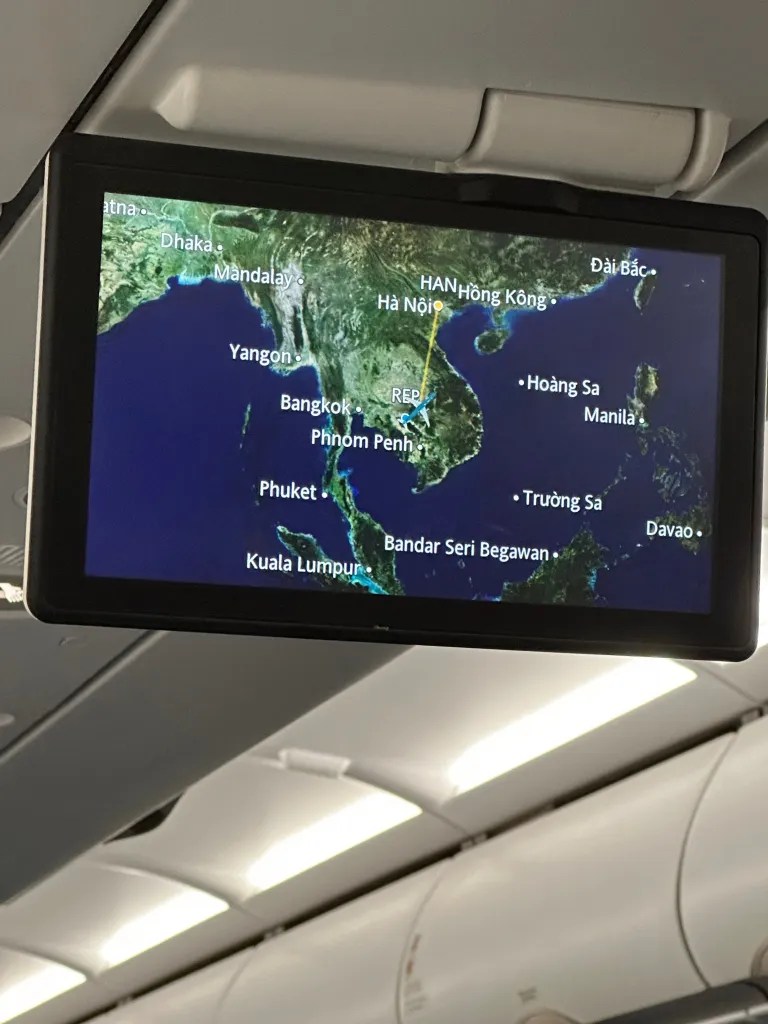
Our next stop was the airport to check-in for our flight to Hanoi. We flew on Vietnam Airlines.

When we landed in Hanoi it was close to 8:00 PM and by the time we picked up our luggage and boarded our bus to the hotel it was after 9:00 PM. The traffic and motorbikes was still very heavy!

A lot of traffic in Hanoi

We had a good view of Hanoi from our hotel room!

View from our hotel room.

Tomorrow we would be exploring Hanoi.

The Magnificent Mekong Day 16

Our Angkor Wat pass was still good so today we visited Angkor Thom. It was the last capital of the Khmer Empire and was well fortified. Angkor Thom when translated from the Khmer language meant “Great Kingdom”. It was built in the late 12th century by King Jayavarman VII.

Five bridges lead into Angkor Thom and they were identical in length, width, and height. Each bridge was decorated with carved stone balustrades that depicted larger than life-sized figures of gods and demons. There were 54 gods on the left and 54 demons on the right.

As we entered we saw a lot of archeological digs happening.

Many of the structures here were made of wood so they were gone. The remaining stone monuments illustrated how magnificent the city was within its walls.

Bayon temple was located in the city of Angkor Thom. It was built almost 100 years after Angkor Wat. Bayon had 216 large smiling faces from 37 towers. The Bayon had three levels. We could not visit the third level due to safety reasons.

Along the temple was a bas-relief that depicted the Khmer Army March.

We walked over to the Terrace of the Elephants. It was part of the walled city of Angkor Thom. It was mainly decorated with carved elephants. It also had a viewing platform for the king to watch his army returning through the grassy field. This wall was once attached to the royal palace.

Then we walked through the Terrace of the Leper King. It was located north of the Terrace of the Elephants. It had bas-reliefs on the Interior and exterior walls and stood almost 23 feet tall. There was speculation of why it was named the Leper King. Most believe it was because one of the former kings had leprosy. The statue of the Leper King was a replica because the original was in a museum in Phenm Penh.

This afternoon we visited H.V.T.O. (Homestay Volunteer Teachers Organization) school. This “school” supplemented the public school education of the rural Cambodians. It was founded by Sim Piseth. He was one of our Cambodian Guides and he wanted to give back to his village. Viking helped this school financially.

When we visited two 14 year old girls picked us and took us around the school grounds and practiced their English!

Our guides and readers

They then showed us the library and picked the book Ten Apples Up on Top by Dr. Seuss. They took turns reading the book to us.

We went with them into the various classrooms. Some of the classes sang a song in English, another did the ABCs, and others explained what they were learning. It was a wonderful afternoon.

In one of the classes a little 8 year old girl came up to me and handed a beautiful picture that she had drawn.

Before we left one of the girls gave us her handwritten biography! It was so special.

Our dinner was at the Mahob restaurant. As the servers were delivering the main course, the lights went out! It wasn’t just at the restaurant but the entire city of Siem Reap! Another guest told us the power had gone off twice in the afternoon. It must be fairly common because the restaurant had battery backup lights to give us a little light and we also used the flashlight on our phones!

The Magnificent Mekong Day 15

This morning we visited Angkor Wat in Siem Reap. Angkor Wat translated from the Khmer language (Cambodia’s official language) as City Temple. This was a temple complex that was the largest religious structure in the world.

It was designed as a Hindu temple to serve King Suryavarman II. By the end of the 12th century it was considered a Buddhist site. It also was an UNESCO World Heritage Site. The five central towers symbolized the peaks of Mt. Meru which according to Hindu mythology was the dwelling place of gods.

The “mountain” was said to be surrounded by an ocean and the moat suggested the oceans were at the edge of the world according to Hindu mytholodgy.

A 617 foot bridge allows access to the site.

Angkor Wat covered 400 acres. It marked the high point of Khmer architecture. You would even find Angkor War on the Cambodian flag.

Our clothing was soaked due to the temperature and humidity.

Angkor Wat was surrounded by heavy forests.

Our guide, Reth, grew up here and he told us stories about Angkor Wat being his playground during the period of unrest in Cambodia before it became a World Heritage Site in 1992.

Reth

After spending the morning at Angkor Wat, we went back to the hotel to clean up and have some lunch. Our lunch consisted of walking from our hotel to the 7-Eleven nearby and picked up a couple of snacks to eat in our room!

This afternoon we went to the market in town. Our guide told us pepper was very popular and of high quality. We bought some Cambodian peppercorns to bring home. We also found our Cambodian Christmas ornament for our International tree.

A portion of the local market

We had some extra time so we walked to the Red Piano where they had a drink called “Tomb Raider” named after Angelina Jolie. When she was here filming part of Tomb Raider she would come to the Red Piano and this was her cocktail.

After the market we had time to freshen up before going out to a lovely restaurant for dinner, Sokkhak River Restaurant. The staff was extremely helpful and careful with our food, especially those of us with dietary restrictions.

Our local restaurant

This afternoon we drove by Pub Street which was lined with restaurants and bars and was known as being the Nightlife spot. Below was a picture taken in the afternoon and another taken after dinner on our way to the hotel.

Tomorrow was a visit to Angkor Thom and a visit to a local school.

The Magnificent Mekong Day 14

This morning we disembarked from the Viking Saigon and boarded our coach to take us to Siem Reap. Viking provided a brown bag with juice, chips, an apple, and a protein bar as a snack to have for our ride.

As we rode along you could see rice drying out on tarps. They do this near the roads because it usually doesn’t flood there.

Our coach made several “comfort” stops along the way and another stop was for our bus driver could have lunch and have a break.

Have you ever seen furniture moved on a flat bed pulled by a tractor?

A clothing store that travels from village to village selling merchandise!

We made a stop at a rubber tree plantation where we saw resin dropping from the trees.

These ants would bite so we stayed away from them!

Another stop was to see an elephant! The elephant made a trek into town once a year for its owner to sell his medicine that we were told helped arthritis!

Before reaching our hotel we made a stop at the entrance of Angkor Wat to get our picture taken for our three day pass.

Angkor Wat Entrance

When we reached our destination we checked into our hotel. We were greeted by some musicians.

The hotel was beautiful! Below are pictures from the lobby and some of the outdoors.

We visited the pool which was refreshing but didn’t cool you off. The water was quite warm from the sun not from any pool heater! At 6:00 AM the water temperature was posted as being 86Ëš F!

Our room had a balcony and a beautiful view of the grounds.

The hotel gifted each of us a Cambodian made scarf when they came to do the evening bed turn down and at dinner we had a Cambodian dance team perform.

Tomorrow we visited Angkor Wat!